
I thought we might take a week off from the normal barrage of economic data.
There will be more earnings next week. There will be another jobs report, another inflation report, another Fed speech, and probably another round of debate about whether AI spending is too high or still not high enough.
This week, I wanted to spend some time on something slower.
The wealth transfer taking place in the United States is enormous, and because it is happening over decades instead of days, it is easy to miss just how much it could change.
Cerulli Associates estimates that roughly $124 trillion will transfer through 2048. About $105 trillion is expected to go to heirs and another $18 trillion to charity. Nearly $100 trillion is expected to come from Baby Boomers and older generations. That is a hard number to get your head around. It is roughly four years of current U.S. economic output.
More interesting to me is how quickly the annual transfer starts to build from here.
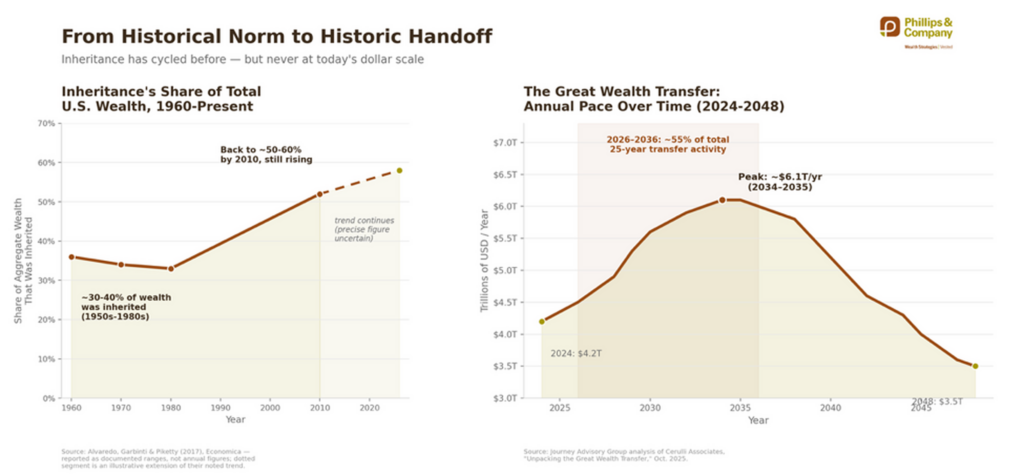
The annual pace is expected to move from roughly $4 trillion today toward about $6 trillion around the middle of the next decade. So, this is already underway. Houses are changing hands. Businesses are changing hands. Portfolios, ranches, real estate, private companies, and family assets are changing hands.
And the people receiving those assets grew up with a very different relationship to money than the people who created them.
That reminded me of the Vanderbilts.
Cornelius Vanderbilt built one of the great American fortunes in shipping and railroads. He started with very little, and by the time he died in 1877, he was one of the richest people in the country. Most of the fortune went to his son, William Henry Vanderbilt.
William actually did a very good job with it. He expanded the railroad interests and roughly doubled the family fortune in the eight years before he died.
That part of the story gets lost because people usually jump straight to the later generations and the mansions.
The more useful part, at least for this discussion, is what changed after William.
The later generations inherited a fortune that had already been built. Their experience with the money was completely different from Cornelius Vanderbilt’s experience creating it, and different again from William’s experience running it.
That seems obvious, but it is probably one of the hardest things for families to deal with.
You can transfer the stock. You can transfer the company. You can transfer the house. You cannot transfer the years that made those assets mean what they mean to the person who built them.
That is where this wealth transfer gets more interesting to me. The next generation is doing better than it feels.
One of the stranger pieces of this is that younger generations are not starting from nothing.
At comparable ages, Millennials in particular have accumulated substantial wealth, and in some cases more than Baby Boomers had accumulated at the same age.
Their confidence tells a very different story.
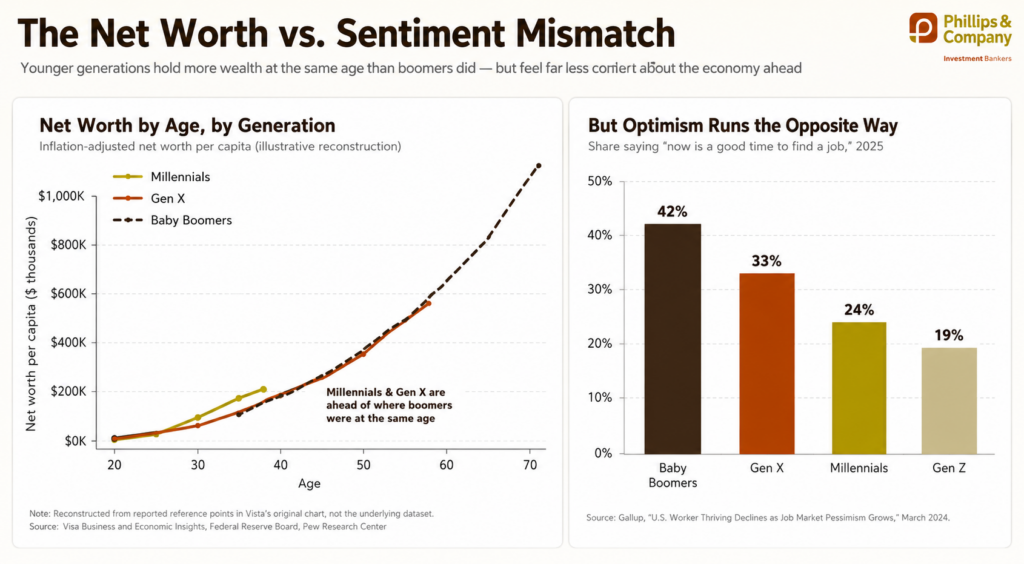
That gap is worth sitting with for a second.
Younger generations can have stronger balance sheets and still feel less secure about the economy ahead.
That is not especially hard to understand. Housing costs are higher. At the same time, student debt is different. Many Millennials came of age during the financial crisis. Then came COVID, inflation, and a housing market that made affordability much harder in many places.
It helps explain another odd piece of data.
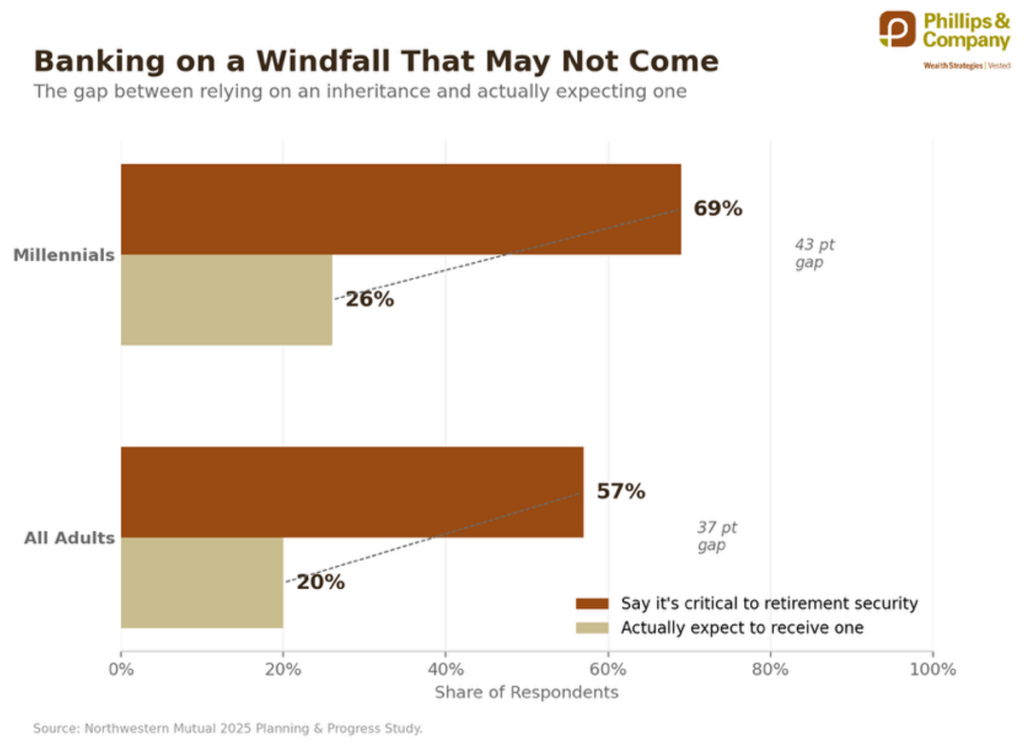
Among Millennials, 69% say an inheritance is critical to their retirement security, but only 26% actually expect to receive one. That is a very large gap between what people feel they need and what they think is actually coming.
And even when inheritance does come, the numbers vary enormously.
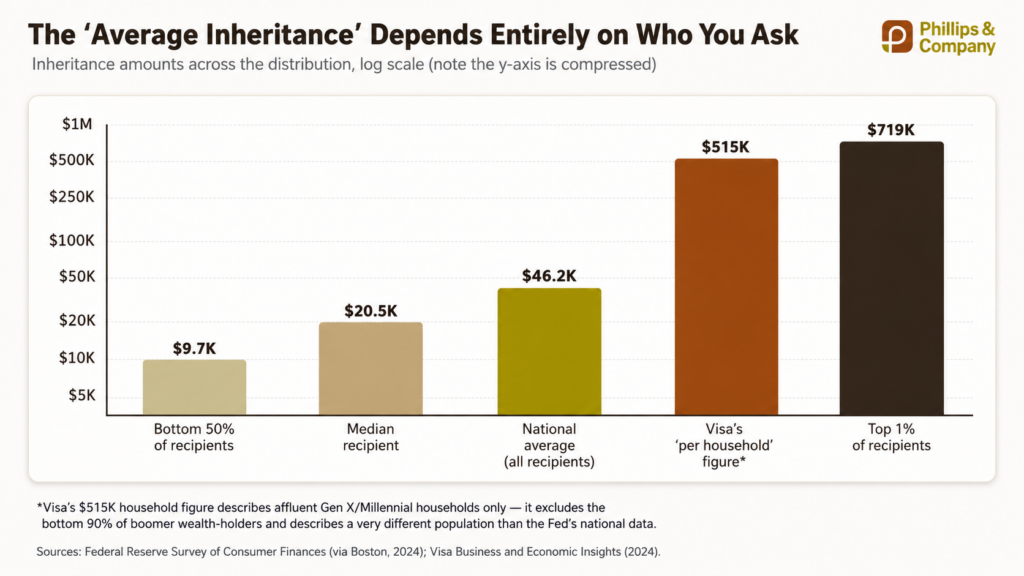
There really isn’t one average inheritance that tells the story. For many households, inheritance will be modest.
For a much smaller group of families, it will be life-changing.
That matters because this wealth transfer is highly concentrated. A large portion of the assets is coming from a very small number of wealthy households.
The aggregate number is $124 trillion. The individual experience will look very different family by family.
A lot of this money will find its way into the economy.
Some of the money will be reinvested, and some of it will be spent.
Visa estimates that of the wealth expected to transfer to heirs through 2046, roughly $8 trillion could ultimately be spent rather than saved or invested.
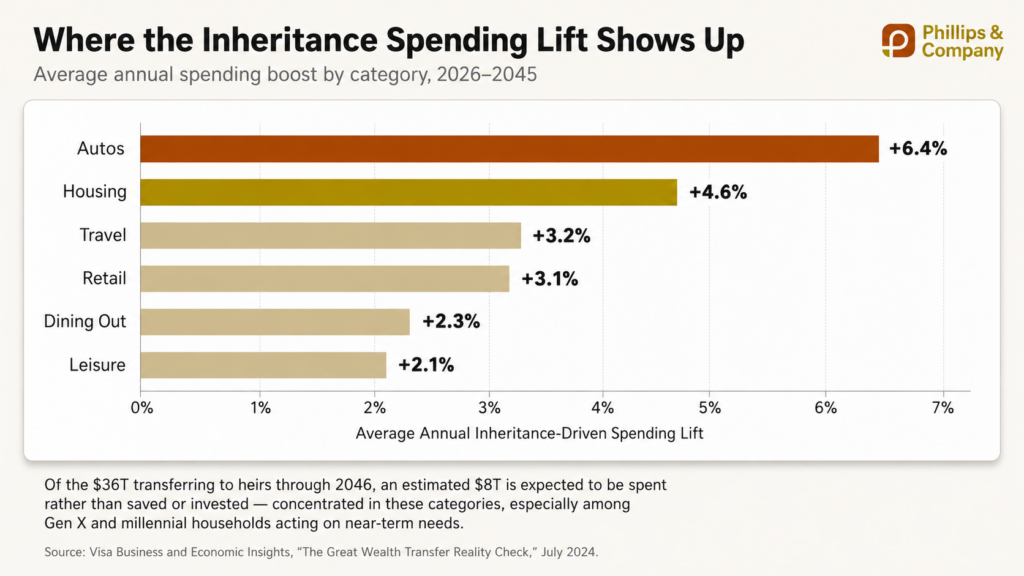
The categories are not surprising.
Cars lead the list, followed by housing, travel, retail, and dining out.
You do not need to spend the inheritance directly for it to affect consumption either. Pay off a mortgage, and monthly cash flow changes. Help a child with a down payment, and their financial life changes.
Eliminate debt, and the amount available to spend every month changes.
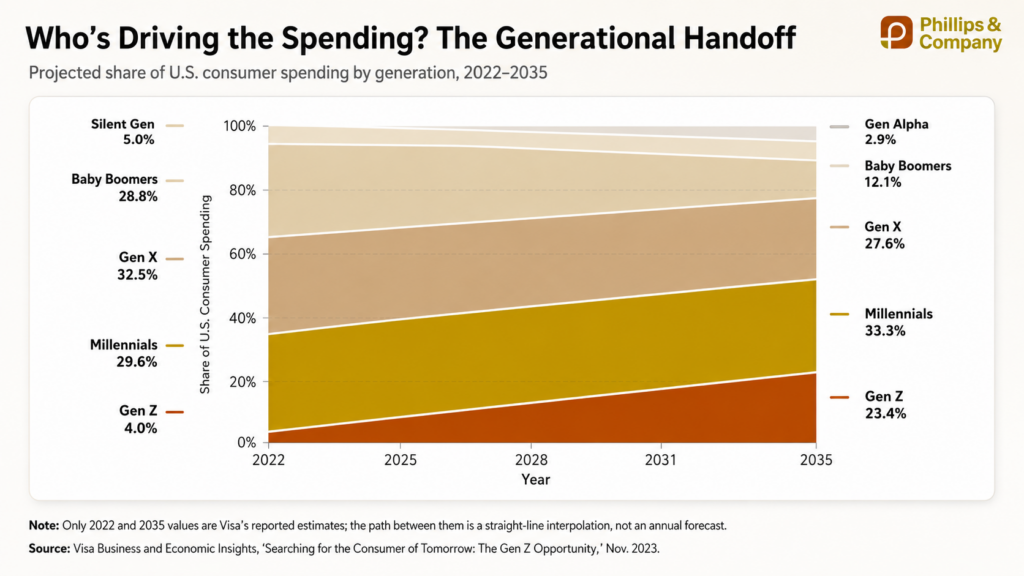
That spending shift is happening at the same time the generations with the money are changing.
This chart may be one of the more useful charts in the piece.
- Gen Z accounted for about 4% of U.S. consumer spending in 2022. By 2035, Visa projects that share at more than 23%.
- Millennials are already a major part of consumer spending and are expected to remain so, growing from 29.6% to 33.3%.
So, the transfer is arriving at the same time these generations are becoming a much larger part of the consumer economy on their own.
That should matter for housing, autos, travel, retail, and probably a lot of categories we have not thought much about yet.
But the more interesting question for investors is what happens to the money that stays invested.
The portfolio is probably going to change too. Younger investors do not invest exactly the way their parents did.
Bank of America found that younger wealthy investors hold a larger share of their portfolios in alternatives and crypto, and a smaller share in traditional stocks than older wealthy investors.
There is also a pretty revealing statistic from FINRA.
Sixty-two percent of investors under age 35 say they feel they need to take big risks to reach their financial goals.
That is a remarkable number, and the behavior underneath it looks different too.
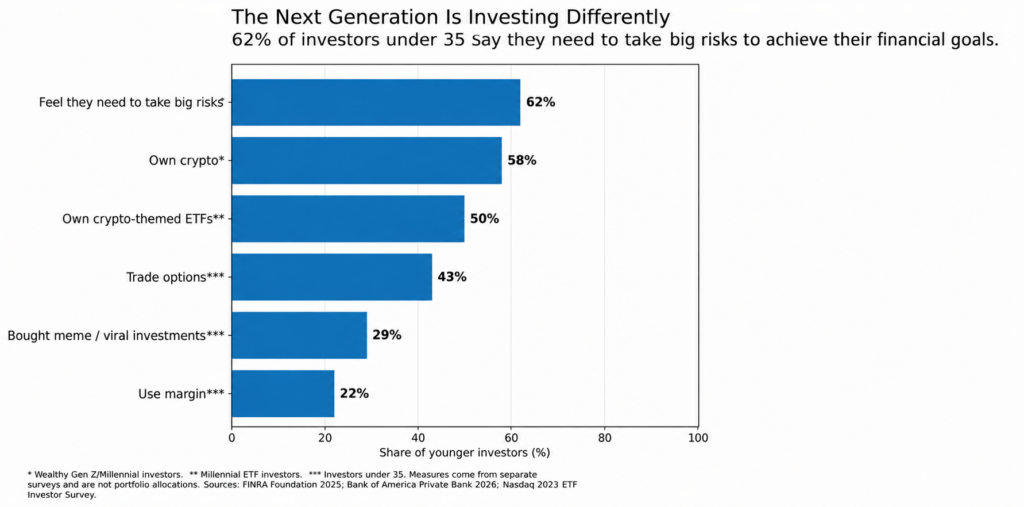
Among investors under 35, 43% trade options, 22% use margin and 29% have bought meme stocks or other viral investments.
Among wealthy younger investors, 58% own crypto. That’s astonishing, and many will be surprised to see their transferred wealth invested in crypto.
Nasdaq found that 50% of Millennial ETF investors and 46% of Gen Z ETF investors own crypto-themed ETFs.
You can debate whether all of that is good investing. I certainly would not recommend every part of it.
But it tells us something about how this generation thinks about capital.
They have grown up watching huge amounts of wealth created in technology, crypto, private equity, venture capital, and businesses that did not exist when their parents started investing.
They have also grown up in a world where home prices rose faster than many incomes and where simply saving more often felt like a pretty slow way to close the gap.
So, I can understand why a younger investor might look at a traditional stock-and-bond portfolio and wonder whether it is enough.
That does not make the conclusion right, but it does help explain the behavior.
And this is where the wealth transfer starts to become more than an estate-planning story.
If trillions of dollars move into the hands of investors who are more comfortable with private markets, alternatives, digital assets, options, and newer investment structures, the ownership of the assets may not be the only thing that changes.
The portfolio itself may change with the owner.
This is the part families usually underestimate.
I keep coming back to the Vanderbilts because there is a part of that story that feels very current.
Cornelius Vanderbilt saw the fortune one way because he built it.
William saw it differently because he inherited it, then had to run it and grow it.
The generations after them had yet another relationship with it and sold it to spend.
That is how money works in families.
A child may see an asset that can be sold.
There is nothing especially surprising about that. They had different experiences.
But families often behave as though the meaning attached to the money will somehow transfer along with the account title, and usually it does not.
That may be the most important part of this whole story.
We have become very good at moving money between generations.
The harder part is helping the next generation understand what the money represented to the people who created it, then letting them decide what it should represent to them.
With $124 trillion beginning to move, we are going to see a lot more families work through that.
And we are probably going to see some pretty meaningful changes in how that money gets spent and where it gets invested once they do.
That’s why, at Phillips & Company, we’ve dedicated tremendous resources to help bridge the gap between the generations and arm the next generation for their future. Ask us about it.
If you have questions or comments, please let us know. You can contact us via X and Facebook, or you can e-mail Tim directly. For additional information, please visit our website.
Tim Phillips, CEO, Phillips & Company
Sources & Data References:
Sources for this week’s discussion include Cerulli Associates’ estimates of the $124 trillion U.S. wealth transfer through 2048; Visa Business and Economic Insights on inheritance, consumer spending and generational spending trends; Northwestern Mutual’s 2025 Planning & Progress Study; Federal Reserve data on inheritance and household wealth; Gallup research on generational economic sentiment; FINRA Foundation research on younger investor behavior; and Bank of America Private Bank and Nasdaq studies on younger investors’ use of alternatives, crypto, options and other nontraditional investments.
The charts and data presented are sourced from a combination of public domain materials and licensed data providers. Their use is intended solely for educational and analytical commentary and falls within the scope of fair use. For a representative list of sources, please click here.
The material contained within (including any attachments or links) is for educational purposes only and is not intended to be relied upon as a forecast, research, or investment advice, nor should it be considered as a recommendation, offer, or solicitation for the purchase or sale of any security, or to adopt a specific investment strategy. The information contained herein is obtained from sources believed to be reliable, but its accuracy or completeness is not guaranteed. All opinions expressed are subject to change without notice. Investment decisions should be made based on an investor’s objective.