
Imagine owning a business where sales are growing, profits are increasing, and customers are continuing to spend. You have enough confidence in the future to invest heavily in new equipment and technology. Your accountant arrives with the latest financial statements, and the results are considerably better than a year ago.
You might expect the value of your business to be increasing.
Wall Street has been taking a different view.
Last week, investors received some of the strongest economic and corporate earnings reports we have seen in years. The economy grew at a 3.4% annualized rate in the third quarter. Consumer spending increased 3.8%, business investment accelerated, and corporate earnings are on pace to grow more than 30% over last year.
By Friday afternoon, the S&P 500 had declined nearly 2% for the day, and the Nasdaq had fallen almost 3%.
Apparently, good news has become a little more difficult to appreciate.
There are legitimate reasons for the market’s concerns, but I think the latest economic reports provide an interesting perspective on the underlying health of the economy and the businesses that make it up.
Let’s start with the consumer.
Consumer spending contributed 2.52 percentage points to third-quarter GDP growth. Business fixed investment added another 1.78 percentage points. Together, those two components contributed more than four percentage points to growth, although a substantial drag from net exports reduced the final number.
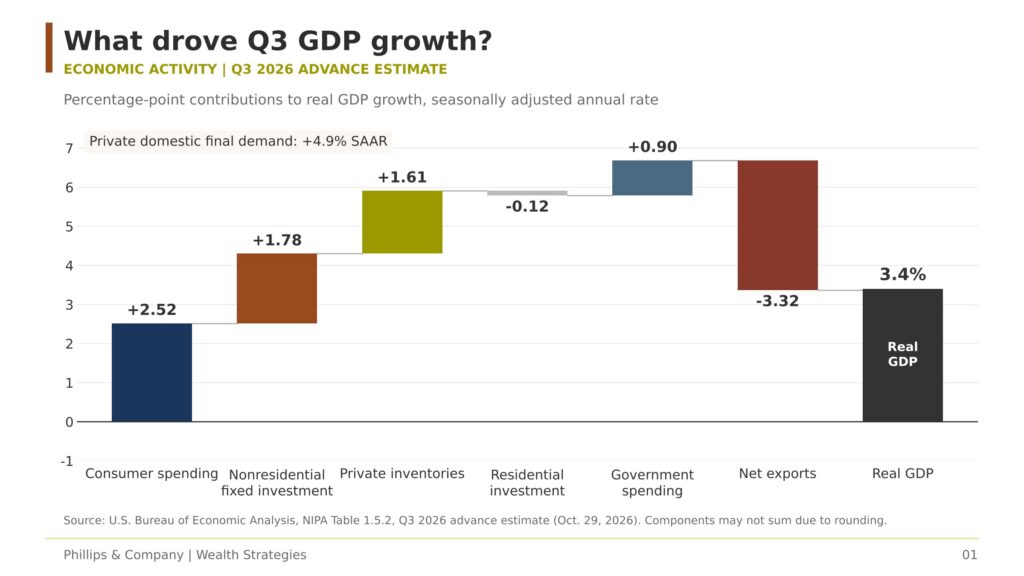
One of my favorite measures of economic activity is real final sales to private domestic purchasers. It removes inventories, government spending, and international trade, giving us a clearer picture of demand within the private economy. That measure increased at a 4.9% annualized rate during the quarter.
It is difficult to reconcile that level of private demand with the suggestion that the economy is approaching a meaningful slowdown.
Consumers continue to spend on health care, travel, restaurants, and other services. Higher interest rates and several years of inflation have certainly affected household budgets, but spending has remained remarkably resilient.
There is, however, an important qualification.
Real consumer spending increased 3.8% during the quarter, while real disposable personal income grew 2.3%.
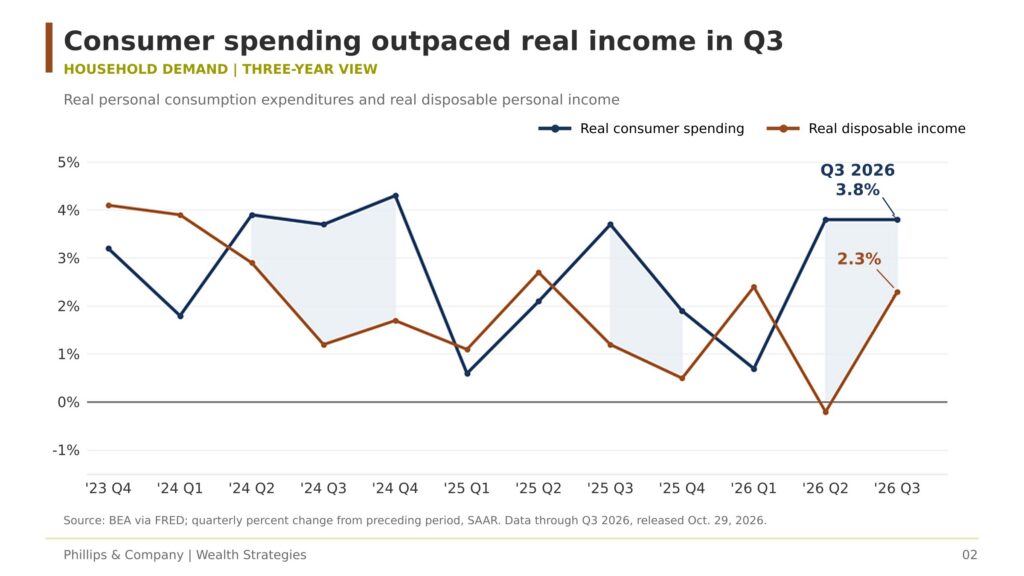
Americans are spending faster than their incomes are growing.
We have seen this relationship before. Households can maintain spending by saving less, borrowing more, or drawing on accumulated assets. Rising home values and financial markets can also influence their willingness to spend.
Eventually, income has to support consumption.
The personal saving rate was just 3.8% in September, leaving less room for consumers to continue financing spending through lower savings. I would expect employment and wage growth to become increasingly important in determining whether the consumer can maintain this pace.
For the moment, the consumer remains a source of economic strength. But I would watch the relationship between income and spending more closely than the headline GDP number.
The other interesting part of the report was business investment.
Nonresidential fixed investment increased 12.7% during the quarter. Equipment investment surged 20.9%, while intellectual-property investment increased 8.4%.
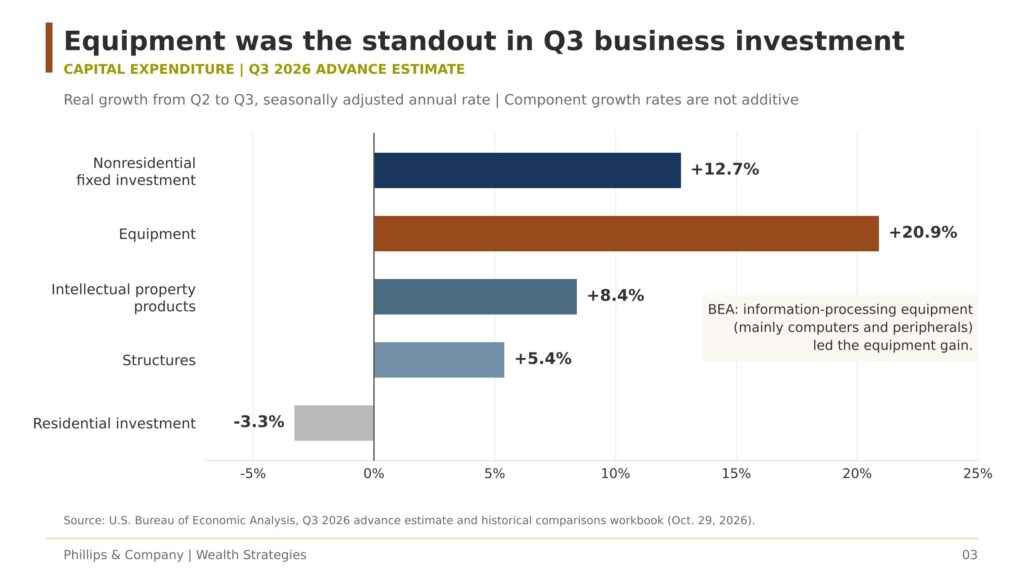
These are unusually strong numbers.
Much of the activity reflects investment in computers, information-processing equipment, and the infrastructure supporting artificial intelligence.
We have spent considerable time discussing the extraordinary amounts of capital being committed to AI. The latest GDP report makes clear that those expenditures are now having a meaningful effect on economic growth.
There is an interesting economic relationship developing here.
When a company builds a data center, the spending contributes to economic activity immediately. The economic benefits are recorded long before anyone knows whether the investment will ultimately generate an attractive financial return.
That is the distinction investors are increasingly focused on.
The technology companies making these investments are among the most profitable and financially capable businesses in the world. But the amount of capital being committed is extraordinary, and investors are beginning to question how quickly the investment will translate into additional profits.
I suspect some of those concerns are reasonable. History provides plenty of examples of industries that correctly anticipated enormous future demand but invested too aggressively in the capacity required to serve it.
The internet and telecommunications buildout of the late 1990s comes to mind. Much of the infrastructure ultimately became essential to the economy, although that was little consolation to investors who financed it at the wrong price.
The benefits of AI may prove substantial. The returns to the companies providing the capital will depend on how those benefits are distributed.
That brings us to corporate earnings.
With approximately 60% of S&P 500 companies having reported third-quarter results, earnings are growing at a blended rate of 30.2% over last year. Revenue growth is running at 13.4%.
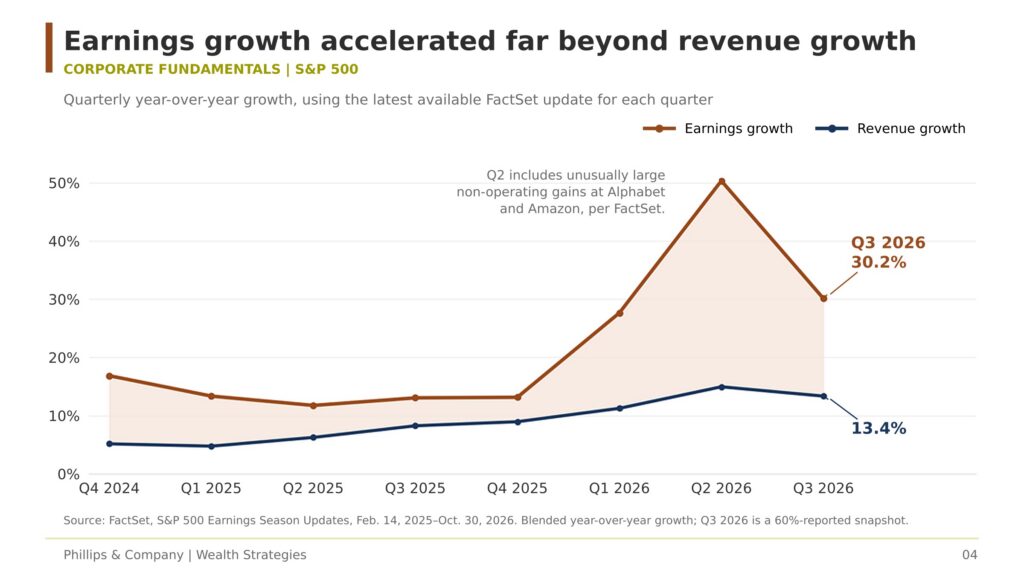
More than 80% of companies have exceeded analysts’ earnings expectations, and all eleven sectors are reporting earnings growth. Those are exceptional results.
Part of the increase reflects operating leverage as companies generate more profit from expanding revenues. There have also been unusually large nonoperating investment gains at certain companies, which make the headline earnings growth somewhat less representative of underlying operating performance.
Even allowing for those items, corporate profitability remains impressive.
Something else caught my attention in the earnings reports.
Although 82% of companies have beaten earnings estimates, the aggregate earnings surprise is just 1.9%, well below historical averages.
Companies are performing exceptionally well, but analysts were already expecting them to. That is probably the real underlying issue. Expectations are so far ahead of what’s normal or even possible that the slight beats on earnings are creating disappointments.
The market has become increasingly demanding, particularly toward companies committing enormous sums to future growth.
Perhaps the most interesting development, however, has been happening quietly in valuations.
At the end of January, the S&P 500 traded at approximately 22.2 times expected earnings over the following twelve months. By October 30, that multiple had declined to 18.7 times.
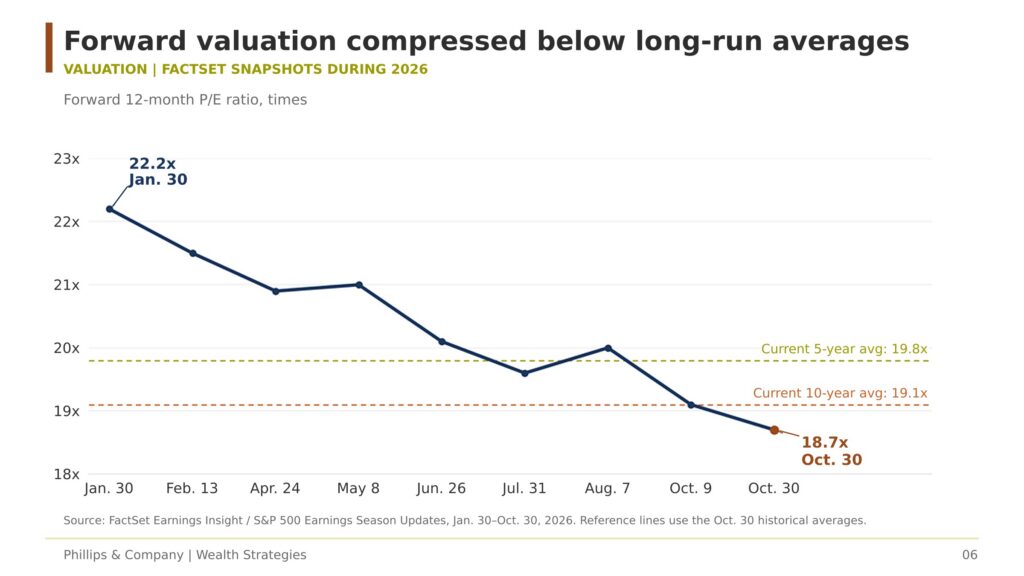
That puts the market below its five-year average of 19.8 and its ten-year average of 19.1.
Investors are now paying considerably less for each dollar of expected corporate earnings than they were earlier this year. Some of that compression reflects rising earnings estimates, and those forecasts will have to be achieved. But the relationship between valuations and future profits has improved.
If consumers continue spending, businesses keep investing, and corporate earnings remain healthy, the Federal Reserve may have less reason to reduce interest rates. Persistent inflation could further complicate that decision.
Investors who have been counting on lower interest rates may find themselves waiting longer than anticipated.
The strength of the economy may actually be contributing to some of the weakness in stock prices.
I have been writing for several months about the price of money and the effect higher rates can have on valuations. I continue to believe that relationship deserves attention.
But valuation matters in both directions.
A market trading at 22 times expected earnings requires considerably more confidence in future growth than one trading below 19 times. The reduction in valuation does not eliminate risk, particularly if earnings expectations prove too optimistic, but it does change the investment calculation.
We should also remember that corporate profits and stock prices do not always move together over shorter periods.
Investors constantly adjust what they are willing to pay for future earnings based on interest rates, uncertainty, and their expectations for economic growth. Those adjustments can be substantial even when underlying business performance remains healthy.
Over longer periods, however, earnings growth remains an important contributor to investment returns.
The latest economic reports suggest that American businesses are performing considerably better than the recent weakness in stock prices might imply.
Markets have a habit of anticipating problems before they appear in the economic data. Sometimes they are right. Other times, investors become so focused on what might go wrong that they overlook what is going right.
The third-quarter reports give us plenty of evidence of what is going right.
I would continue to expect volatility as investors work through questions about interest rates, capital spending, and future profitability. The more important issue for long-term investors is whether corporate earnings can continue to grow.
For now, the evidence remains encouraging, even if the stock market doesn’t seem particularly impressed.
If you have questions or comments, please let us know. You can contact us via X and Facebook, or you can e-mail Tim directly. For additional information, please visit our website.
Tim Phillips, CEO, Phillips & Company
Sources & Data References:
Economic data referenced in this commentary are from the U.S. Bureau of Economic Analysis (BEA), including the Third Quarter 2026 Advance GDP Estimate released October 29, 2026, and the Personal Income and Outlays reports. Corporate earnings, revenue growth, earnings surprises, and historical valuation comparisons are from FactSet Earnings Insight reports through October 30, 2026. Additional market and economic data are drawn from the Federal Reserve Bank of St. Louis (FRED), the Federal Reserve, and S&P Dow Jones Indices. All data reflect information available as of October 30, 2026, and are subject to subsequent revisions.
The charts and data presented are sourced from a combination of public domain materials and licensed data providers. Their use is intended solely for educational and analytical commentary and falls within the scope of fair use. For a representative list of sources, please click here.
The material contained within (including any attachments or links) is for educational purposes only and is not intended to be relied upon as a forecast, research, or investment advice, nor should it be considered as a recommendation, offer, or solicitation for the purchase or sale of any security, or to adopt a specific investment strategy. The information contained herein is obtained from sources believed to be reliable, but its accuracy or completeness is not guaranteed. All opinions expressed are subject to change without notice. Investment decisions should be made based on an investor’s objective.