
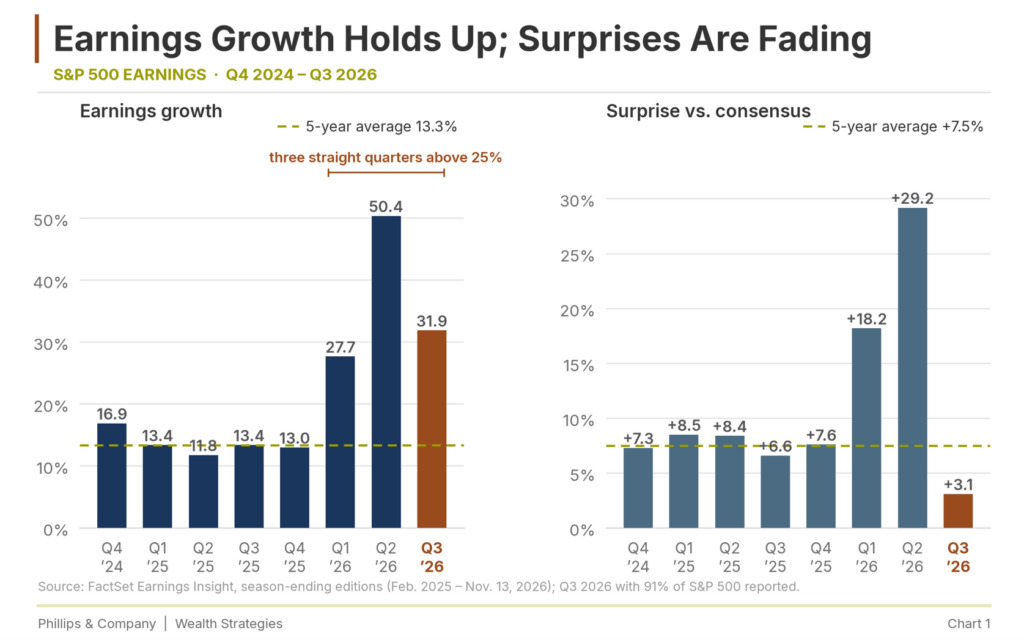
Corporate America continues to deliver impressive results. With more than 90% of S&P 500 companies having reported third-quarter earnings, 84% have exceeded analysts’ expectations. Earnings growth is running at approximately 32%, supported by strong revenue growth and particularly impressive results from technology companies.
The interesting part is that investors seem increasingly reluctant to celebrate.
Companies are beating earnings estimates, but the magnitude of those surprises is considerably smaller than we have become accustomed to. According to FactSet, earnings are coming in just 3.1% above expectations, compared with a five-year average of 7.5%. Expectations have moved higher along with profits, leaving less room for disappointment.
The earnings strength is encouraging, especially given the economic and political uncertainty of the past several months. But the market is also beginning to question how much of that growth depends on the extraordinary investment taking place in artificial intelligence.
That brings us to Nvidia.
Nvidia’s Moment of Uncertainty
Nvidia reports earnings on Tuesday, November 17, under circumstances few investors could have imagined just weeks ago. Jensen Huang, the company’s co-founder and the public face of the AI revolution, resigned on November 12 following revelations about personal relationships that raised serious governance and national security concerns. Longtime CFO Colette Kress has been appointed interim CEO.
Nvidia’s shares declined 4.3% on Thursday following the announcement, after falling considerably more during the trading session. By Friday’s close, the stock was approximately 30% below its October 6 high.
The departure of Huang introduces uncertainty at a particularly important moment. Few CEOs have been as closely associated with their company’s strategy, technology, and customer relationships. His influence extended well beyond Nvidia into the broader AI industry and the political debate surrounding advanced chip exports.
Yet the business he leaves behind is producing extraordinary numbers.
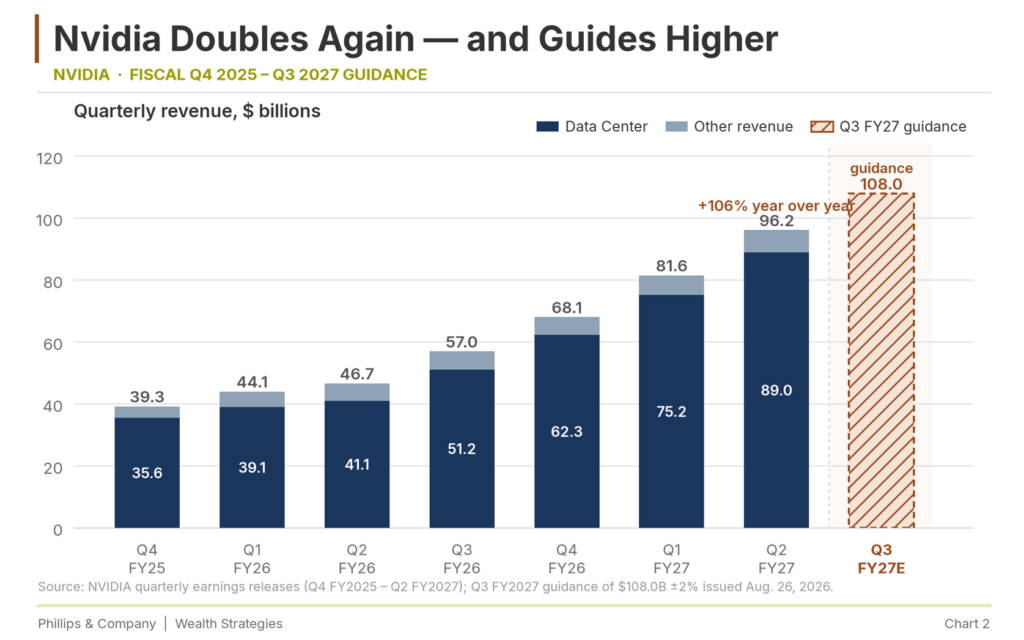
Nvidia generated $96.2 billion in revenue during its most recent quarter, more than double the previous year’s level. Management’s guidance calls for approximately $108 billion in the upcoming report. Data centers account for the overwhelming majority of that revenue.
We will be watching the revenue figures, but equally important will be management’s comments on customer spending, chip demand, export restrictions, and the company’s ability to execute without Huang.
The Largest Capital Investment Cycle in a Generation
Nvidia’s customers are spending enormous amounts of money building the infrastructure necessary to support artificial intelligence.
Microsoft, Amazon, Alphabet, Meta, Oracle, and other companies are investing in semiconductor chips, computing equipment, networking, data centers, and electricity infrastructure. Their spending supports an expanding network of equipment manufacturers, construction companies, utilities, and technology suppliers.
The scale is remarkable, and so are the financial commitments.
Much of this investment is being financed by businesses with substantial earnings and cash flow. That provides an important advantage over previous technology investment cycles. Nevertheless, even the most profitable companies have limits on how much capital they can commit without eventually demonstrating adequate returns.
The return on investment will ultimately depend on whether businesses and consumers are willing to pay enough for AI products and services to support the cost of building and operating this infrastructure.
The investment decisions are being made today. The cash flows expected to justify them may arrive over many years.
AI Is Becoming an Important Part of Economic Growth
The economic impact of this spending is already showing up in the GDP numbers.
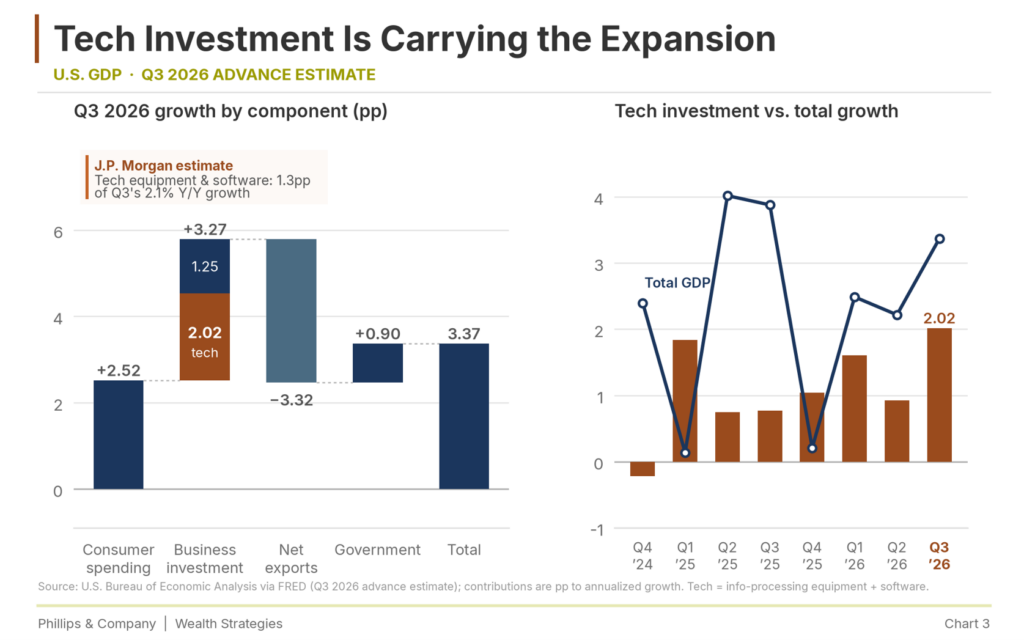
Third-quarter real GDP grew at a 3.4% annualized rate, accelerating from 2.2% in the previous quarter. Consumer spending remained an important contributor, while investment helped drive the acceleration.
J.P. Morgan estimates that investment in information-processing equipment and software contributed approximately 1.3 percentage points to the economy’s 2.1% year-over-year growth in the third quarter. That is a remarkable contribution from one category of investment.
This measure includes technology spending beyond AI, and imported equipment reduces the direct contribution to domestic production. Still, the increasing importance of technology investment is difficult to overlook.
We are beginning to see how a capital spending cycle concentrated among a relatively small group of companies can influence the direction of the entire economy.
Construction creates jobs. Equipment orders support manufacturing. Electricity demand encourages investment in power generation and transmission. These activities generate economic growth well before the finished data centers produce the revenues their owners anticipate.
That raises a consideration for investors. If capital spending continues to accelerate, the economic benefits could extend well beyond technology. If companies eventually slow their investment because returns disappoint or financing becomes more expensive, the effects could also spread across the economy.
Inflation and the Price of Money
The latest inflation report adds another complication.
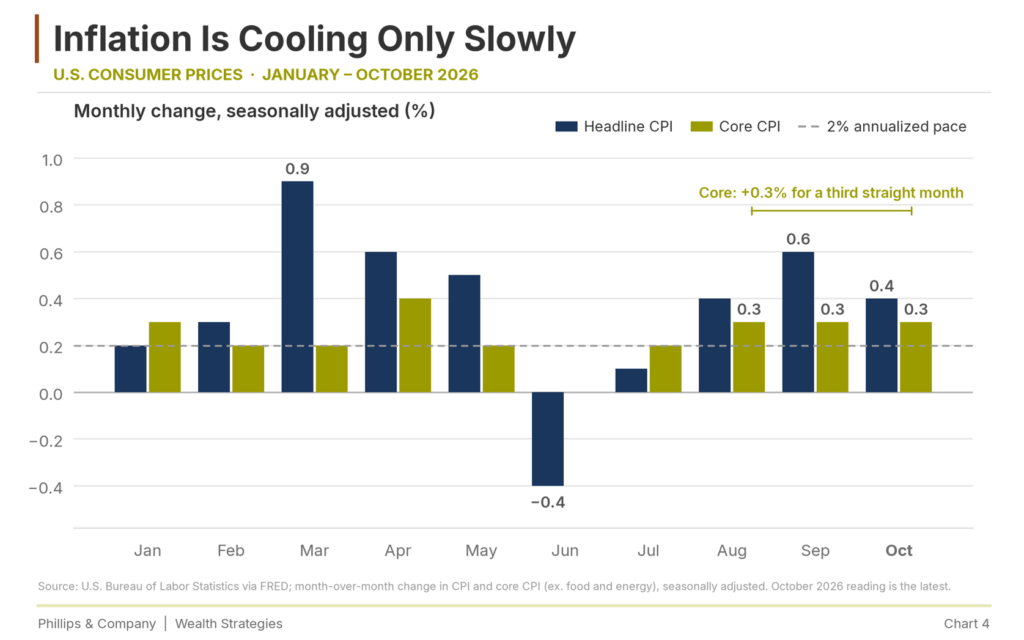
Consumer prices increased 0.4% in October, following a 0.6% increase in September. Core prices, excluding food and energy, increased 0.3% for the third consecutive month. Food, shelter, and energy costs continue to place pressure on households.
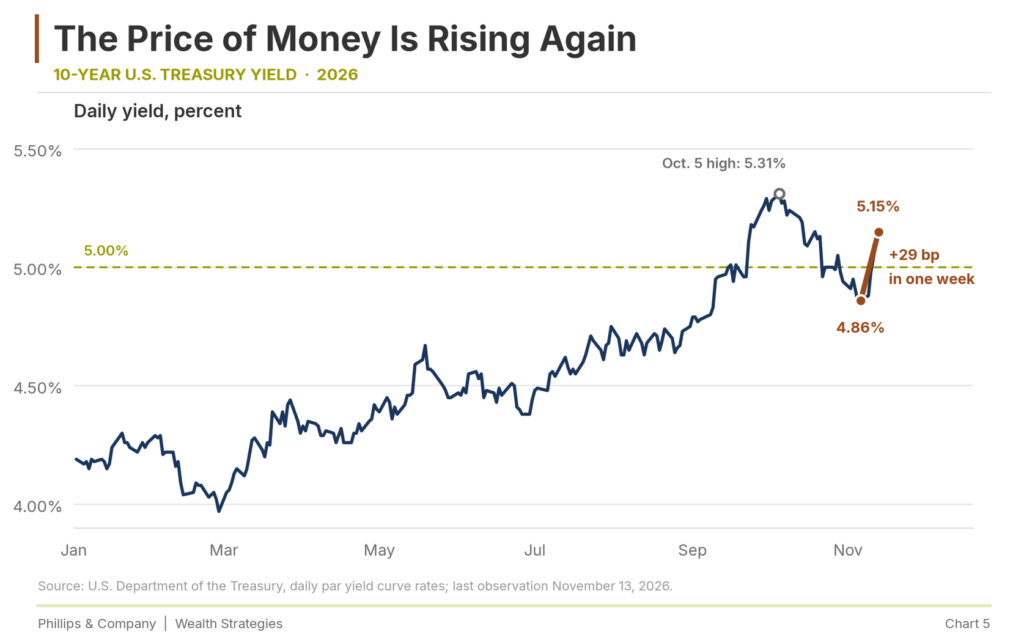
The bond market has responded. The 10-year Treasury yield reached 5.15% on Friday, November 13, up from 4.86% just one week earlier.
A 29-basis-point increase in a single week is meaningful, particularly for an economy undertaking such a large investment program.
Higher interest rates affect the economics of new investment. Data centers require substantial upfront capital, and their profitability depends on revenues generated over many years. Higher financing costs raise the return these projects must earn to justify their construction.
For investors, higher Treasury yields also change the valuation equation. Future corporate profits are worth less when discounted at higher interest rates, and bonds become more competitive with equities.
There is an additional tension developing in the AI industry. Data centers require enormous amounts of electricity, construction materials, specialized equipment, and skilled labor. Rapid investment can put pressure on the supply and cost of those resources, particularly where capacity is already constrained.
That does not necessarily translate into higher economy-wide inflation, but it creates another challenge for companies trying to control the cost of their projects.
The Next Phase of Growth
I remain encouraged by the strength of corporate earnings and the resilience of the U.S. economy. Businesses have continued to produce impressive profits despite higher borrowing costs and persistent inflation.
The AI investment cycle could eventually deliver substantial productivity improvements, helping companies produce more with fewer resources. That would be an important benefit for both corporate profitability and economic growth.
In the meantime, investors are financing a very expensive transition.
Nvidia’s upcoming earnings will provide another indication of how quickly the spending is expanding and how much confidence its largest customers have in future demand. The company’s leadership transition introduces an additional risk, although the underlying demand for computing power does not disappear with the departure of its CEO.
The broader economy is benefiting from this spending today. The longer-term results will depend on the profits these investments eventually generate.
With Treasury yields above 5%, the cost of capital deserves considerably more attention than it did when money was inexpensive.
Corporate earnings have been strong enough to support the market. Whether that continues will depend on the next phase of investment producing returns that justify both the spending and the valuations investors have assigned to it.
If you have questions or comments, please let us know. You can contact us via X and Facebook, LinkedIn, or you can e-mail Tim directly. For additional information, please visit our website.
Tim Phillips, CEO, Phillips & Company
Sources & Data References:
FactSet Earnings Insight (November 13, 2026); NVIDIA Investor Relations, quarterly earnings releases, revenue guidance and corporate announcements; Bureau of Economic Analysis, third-quarter 2026 GDP estimates; J.P. Morgan Asset & Wealth Management, AI Tracker (November 2026); Bureau of Labor Statistics, October 2026 Consumer Price Index report; U.S. Department of the Treasury, daily Treasury yields through November 13, 2026; and Reuters and Associated Press coverage of NVIDIA’s leadership developments, AI infrastructure investment and market performance.
The charts and data presented are sourced from a combination of public domain materials and licensed data providers. Their use is intended solely for educational and analytical commentary and falls within the scope of fair use. For a representative list of sources, please click here.
The material contained within (including any attachments or links) is for educational purposes only and is not intended to be relied upon as a forecast, research, or investment advice, nor should it be considered as a recommendation, offer, or solicitation for the purchase or sale of any security, or to adopt a specific investment strategy. The information contained herein is obtained from sources believed to be reliable, but its accuracy or completeness is not guaranteed. All opinions expressed are subject to change without notice. Investment decisions should be made based on an investor’s objective.