
There is an old saying that if you don’t know who is losing at the poker table, there’s a good chance it’s you.
I suspect a growing number of Americans have that uneasy feeling about the economy. They go to work, earn a paycheck, pay their bills, and wonder why getting ahead seems harder than it used to be. They can’t quite put their finger on it, but they know something isn’t adding up.
And the data suggests they’re onto something.
The American worker isn’t losing because the economy has stopped growing. Quite the opposite. Productivity has risen dramatically, corporate profits remain strong, and Americans continue to spend. The problem is that the rewards of that growth haven’t been shared equally between those who supply the labor and those who own the capital.
The American worker is participating in the growth of the economy. The American shareholder is participating in the ownership of it. Those are two very different things.
The Paycheck Isn’t Keeping Up
Between 2020 and 2026, cumulative inflation approached 30%, exceeding the increases experienced during most comparable six-year periods over the past four decades.
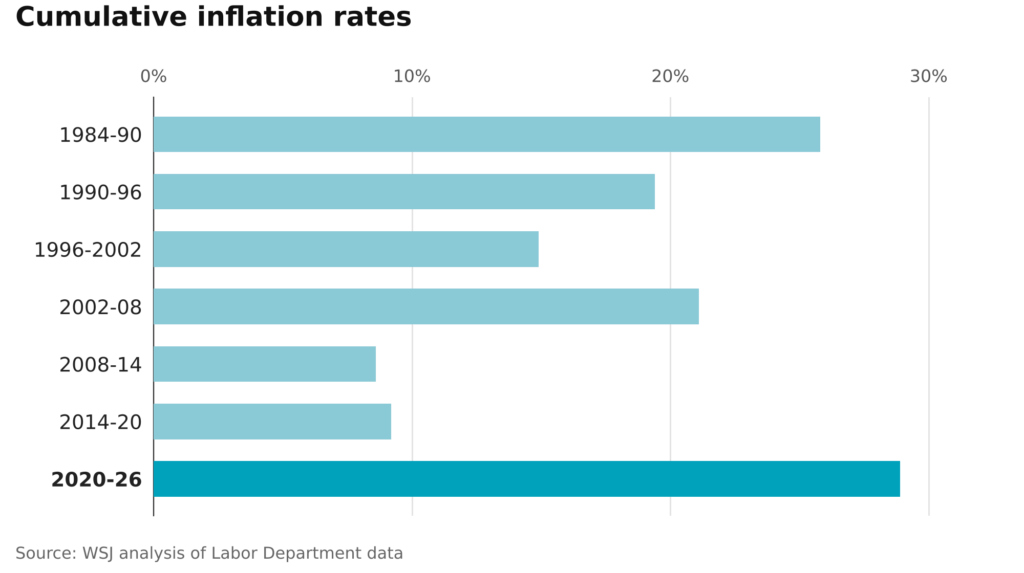
That’s a permanent reset in the price level, not just an unpleasant inflation report.
Inflation coming down doesn’t mean prices are coming down. It simply means they’re rising more slowly. The family that saw its grocery bill, insurance premiums, rent, and utility costs jump over the past six years doesn’t get that money back when inflation moderates.
For much of 2024 and 2025, real wage growth offered some relief. More recently, however, average hourly earnings have again struggled to keep pace with inflation.
The paycheck may be larger, but its purchasing power is under pressure.
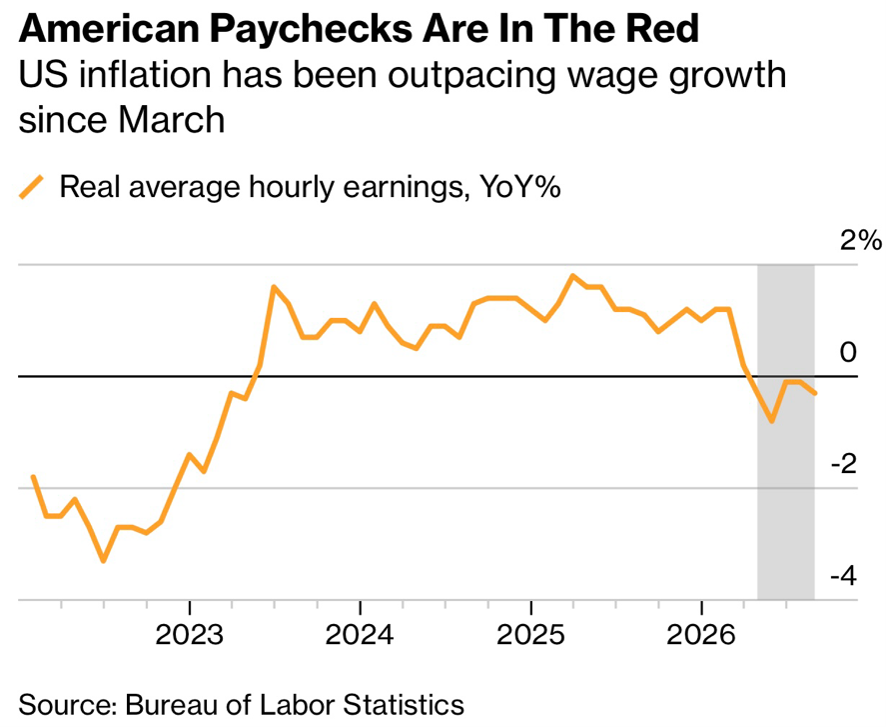
Americans don’t live in percentages. They live with the cost of groceries, housing, health care, and the things their children need.
The Great Divide Between Labor and Capital
Now consider something far more consequential than any single inflation report.
Since 1973, American labor productivity has increased by approximately 156%. Over that same period, real hourly compensation, including benefits, has risen by about 64%. Both are meaningful gains, but the difference is enormous.
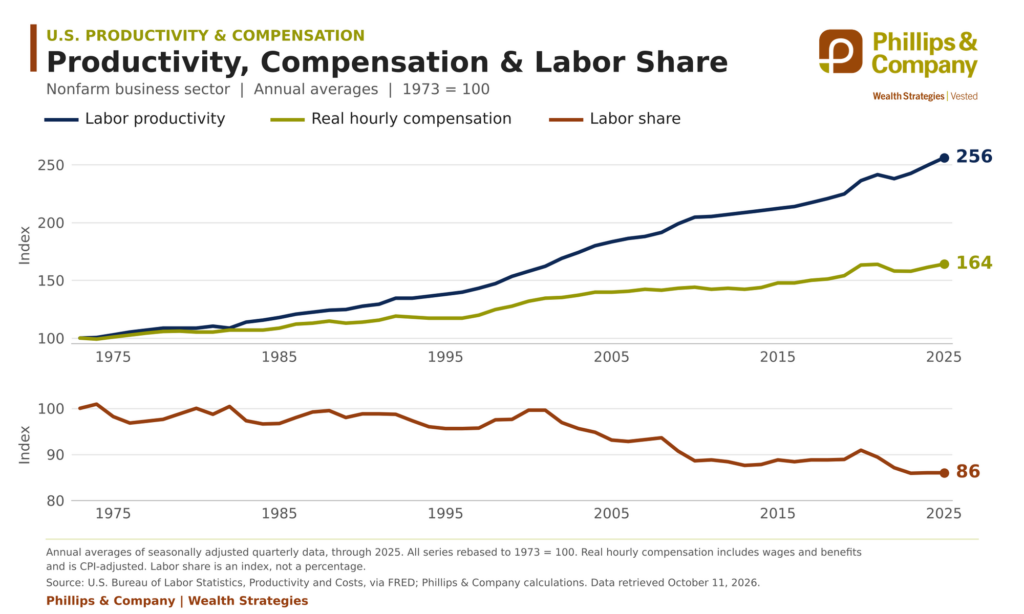
American businesses have become dramatically more productive, yet workers’ inflation-adjusted compensation hasn’t kept pace with that productivity.
Meanwhile, labor’s share of economic output has declined. The portion of the economic pie going to workers has gotten smaller, while a greater portion has accrued elsewhere, including to capital.
Technology, globalization, automation, changing bargaining power, and differences in how prices are measured all contribute to this divergence. It would be too easy, and intellectually dishonest, to blame any single company, administration, or political party. But the direction is difficult to ignore.
For decades, we’ve celebrated the extraordinary productive power of the American economy. And rightly so. What we haven’t discussed enough is who owns the benefits of that productivity.
Working harder and producing more isn’t the same as accumulating wealth. Ownership is what connects the two.
Corporate America Is Doing Just Fine
Now look at the other side of the ledger.
The S&P 500’s estimated net profit margin for the third quarter of 2026 is 15%, compared with approximately 9.3% a decade ago. That’s a 61% increase in profit margins. Information technology margins are estimated at an extraordinary 32.3%, while financials are approaching 20%.
Corporate earnings are expected to grow nearly 27% year over year in the third quarter, with technology leading the way.
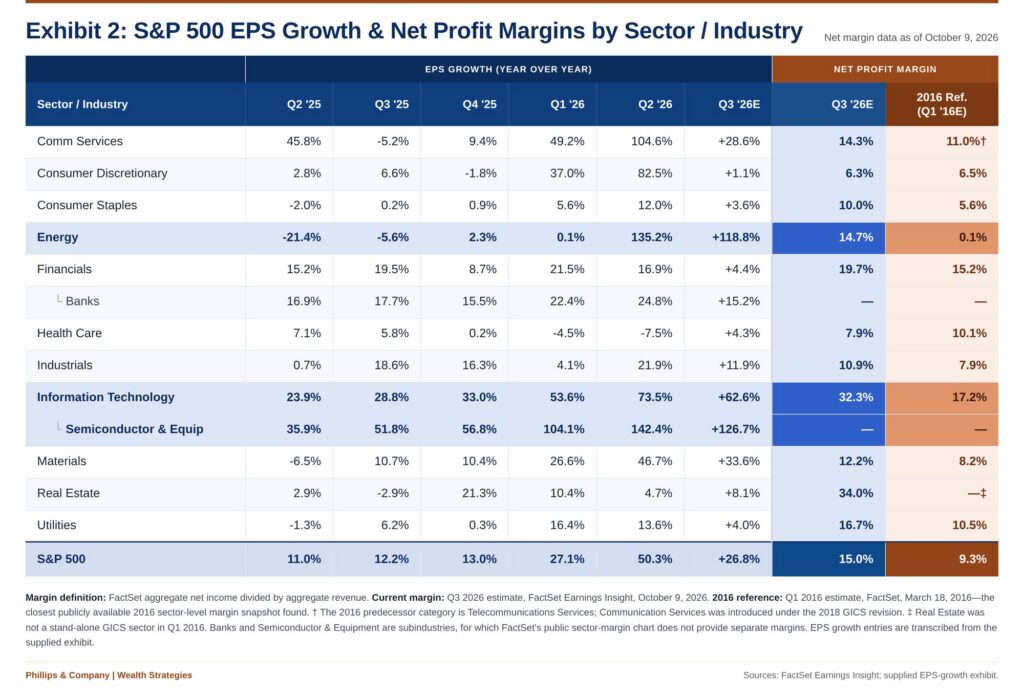
These are remarkable numbers.
I don’t begrudge companies their success. Profits allow businesses to invest, hire, innovate, and ultimately create wealth. Without profits, there would be little reason to own equities in the first place.
But there’s an uncomfortable reality in these numbers.
When productivity grows faster than compensation, and profit margins expand, shareholders may enjoy economic rewards that workers don’t necessarily receive through their paychecks. (This is why participating in your company 401(K) is so critical- own some equities)!
This helps explain why the stock market can be setting records while a meaningful portion of the population feels financially insecure.
Both experiences can be true at the same time.
We’ve Become Very Good at Spending
Perhaps the most interesting part of this story is how Americans respond.
Despite elevated prices and household budgets under pressure, consumer spending continues to hold up. Bank of America’s August data showed household card spending rising 4.5% from a year earlier. The longer-term spending data also reveal meaningful differences between income groups.
Americans continue to consume, even when they feel financially constrained.
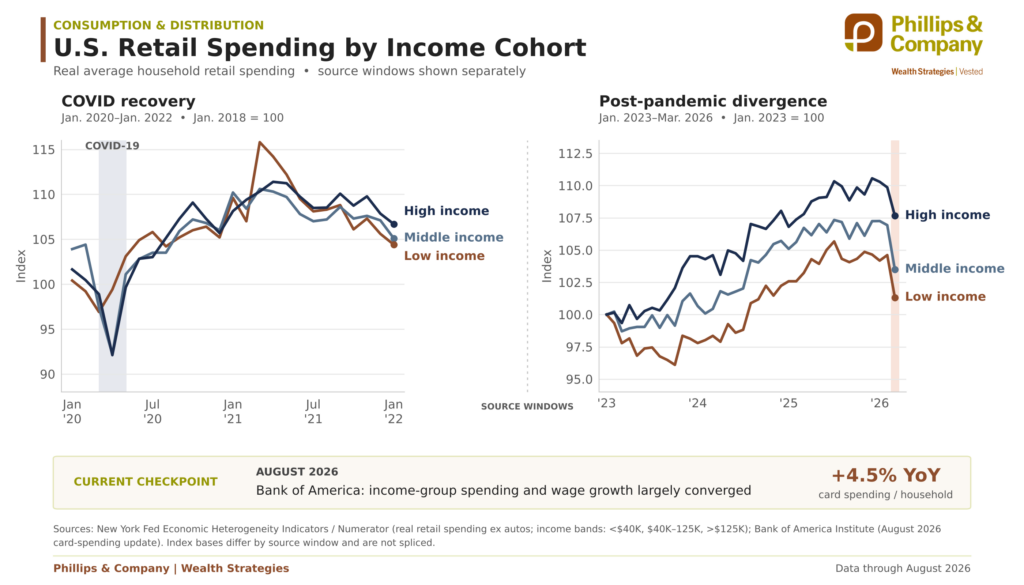
I was recently reminded of a quote attributed to Tim Jackson that captures something uncomfortable about our relationship with money:
“We are being persuaded to spend money we don’t have, on things we don’t need, to create impressions that won’t last, on people we don’t care about.”
There’s a lot of truth in that observation.
We have built a consumption-driven culture that encourages us to measure success by what we purchase rather than what we own. Bigger homes, newer cars, the latest technology, experiences, subscriptions, and an endless parade of things we didn’t know we needed until someone convinced us otherwise.
I’m not arguing against consumption. It’s the backbone of our economy. Enjoying the fruits of our labor is part of living a good life. But somewhere along the way, we’ve confused spending money with building wealth.
A purchase delivers satisfaction today. An investment gives us a claim on tomorrow’s productive economy.
And here’s the irony.
The same Americans buying products, subscriptions, and services from the country’s most profitable companies may own little or none of those businesses.
We’ve become very good at being customers of capitalism. We need to become better at being owners of it. Owning equities in spite of their natural drawdowns moves us to owners.
When Getting Ahead Feels Impossible
I wonder whether this disconnect helps explain some of the growing social and political frustration we’re seeing.
When people believe working hard will eventually provide financial security, there is a natural willingness to be patient. But when that relationship begins to feel broken, patience wears thin.
It isn’t difficult to understand why political movements promising to redistribute wealth or challenge the existing economic structure find an increasingly receptive audience.
Whether those proposals would actually improve the economic position of workers is another question. But the frustration underlying them is real and deserves to be taken seriously.
We’re seeing another interesting response: the extraordinary appetite for speculation.
Prediction markets, sports betting, and short-term trading have become remarkably popular. Platforms such as Kalshi, Robinhood, and DraftKings have made participation easier than ever.
Selected measures of wagering and event-contract activity rose more than sixfold between the second quarters of 2025 and 2026.
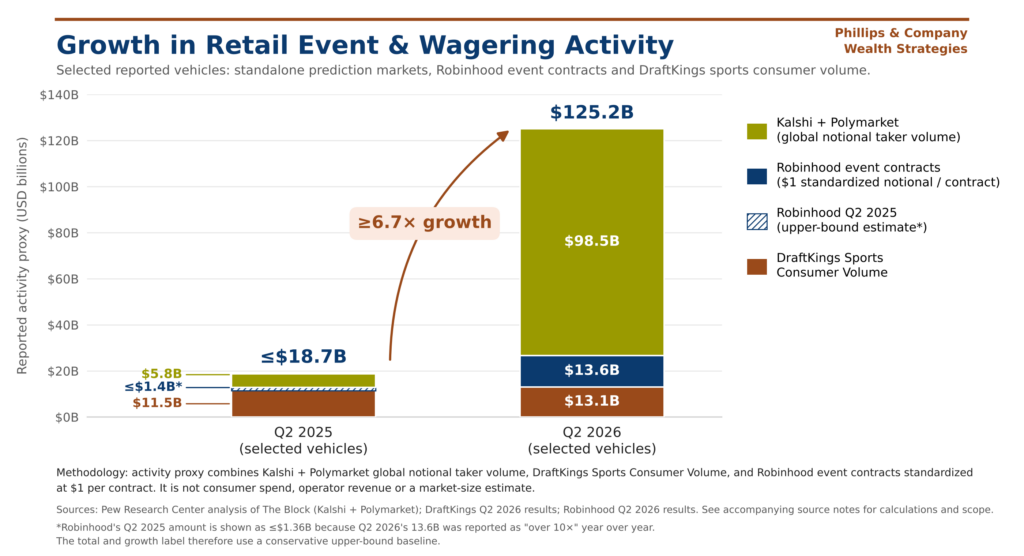
That doesn’t mean everyone placing a wager is financially desperate. Entertainment, technology, and accessibility all play a role. But I suspect the appeal of a quick financial win becomes stronger when the traditional path toward prosperity feels painfully slow.
There’s a certain irony in using an app to speculate on tomorrow’s headlines while overlooking the opportunity to own a piece of the businesses that may generate profits for decades.
Speculation offers the possibility of getting rich quickly. Ownership offers a more credible, though never guaranteed, opportunity to build wealth gradually.
Those are fundamentally different propositions.
Stop Renting the Economy
I don’t believe the answer to this divide is to discourage profits, punish successful companies or convince Americans that capitalism is hopelessly stacked against them. This, in fact, will fuel more equity growth for investors.
I do not think every household has the same capacity to invest. When housing, food and, health care consume most of the paycheck, telling someone to buy stocks isn’t particularly helpful. We need to acknowledge that reality.
But for families with the ability to save, even modestly, the lesson is important. Even if it’s only saving in your 401(K) plan.
The long-term advantage in our economy has increasingly accrued to those who own productive assets: equities, businesses, 401(k) plans, and real estate. These assets can appreciate, generate income, and participate in economic growth. They involve risk, but they also offer something that earned income alone generally cannot.
A paycheck compensates us for the work we did. Ownership gives us a claim on some of the value an asset may create in the future.
That’s why I continue to believe building equity ownership should be a central financial objective for American families.
Not trading more. Not chasing the next hot investment. And certainly not trying to make up for lost time at the betting window.
Owning more.
Perhaps the greatest financial divide in America isn’t simply between high-income and low-income households. It’s between those who rely entirely on earned income and those who have accumulated assets that also work on their behalf.
The American worker hasn’t stopped contributing to this country’s prosperity. Far from it. The productivity data make that abundantly clear.
But contributing to prosperity and participating in the wealth it creates are not the same thing.
If labor is losing ground to capital, the answer for more Americans should be to own some capital. After all, there’s nothing wrong with working for a successful company.
If you have questions or comments, please let us know. You can contact us via X and Facebook, or you can e-mail Tim directly. For additional information, please visit our website.
Tim Phillips, CEO, Phillips & Company
Sources & Data References:
Data and analysis referenced in this commentary are drawn from the U.S. Bureau of Labor Statistics (Consumer Price Index, real average hourly earnings, labor productivity, compensation and labor share); the Federal Reserve Bank of St. Louis (FRED); the Federal Reserve Bank of New York and Numerator (retail spending by household income); Bank of America Institute (August 2026 Consumer Checkpoint); FactSet Earnings Insight (October 9, 2026, S&P 500 earnings growth and profit margins); and The Wall Street Journal’s analysis of historical inflation. Prediction market and wagering activity reflects reported data from Kalshi, Polymarket, Robinhood and DraftKings, as compiled in Phillips & Company’s research. The observation on consumer spending is attributed to Tim Jackson. Historical results and estimates are not guarantees of future performance.
The charts and data presented are sourced from a combination of public domain materials and licensed data providers. Their use is intended solely for educational and analytical commentary and falls within the scope of fair use. For a representative list of sources, please click here.
The material contained within (including any attachments or links) is for educational purposes only and is not intended to be relied upon as a forecast, research, or investment advice, nor should it be considered as a recommendation, offer, or solicitation for the purchase or sale of any security, or to adopt a specific investment strategy. The information contained herein is obtained from sources believed to be reliable, but its accuracy or completeness is not guaranteed. All opinions expressed are subject to change without notice. Investment decisions should be made based on an investor’s objective.