
There is a reason airplane wings bend.
Watch one from a window seat in turbulence and it can be a little unsettling. The wing moves far more than most passengers would like. But that flexibility isn’t a defect. It is part of what keeps the airplane in the sky. A perfectly rigid wing would have a much harder time absorbing the forces acting on it.
Economies aren’t all that different.
We spend a lot of time looking for signs that something is either strong or weak. Expansion or recession. Bull market or bear market. Consumer healthy or consumer broken.
The real world is usually somewhere in between.
And right now, the American economy looks like it is bending.
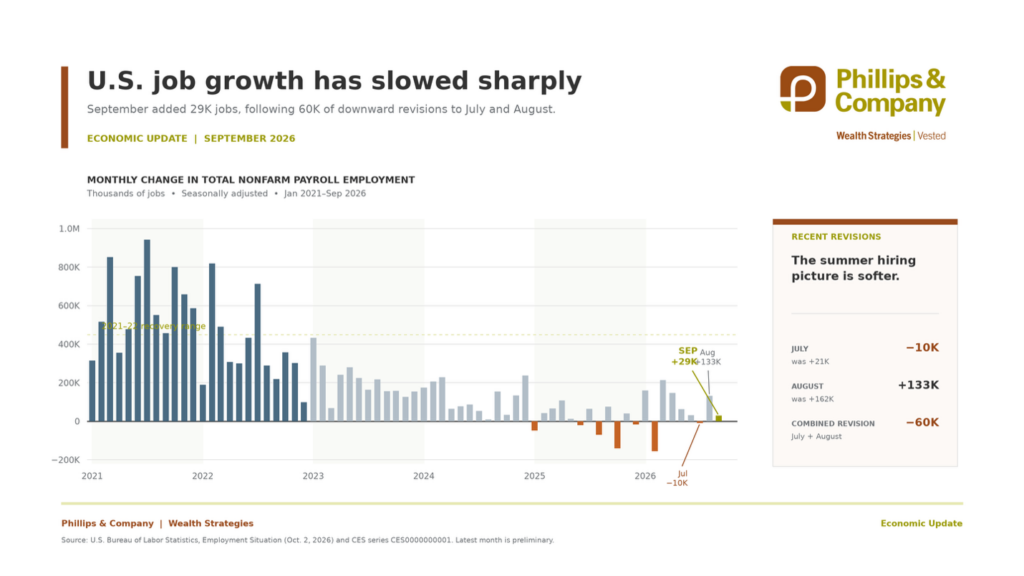
Friday’s employment report was a pretty good example. The economy added just 29,000 jobs in September, well below expectations. July and August were revised down by another 60,000 jobs, and unemployment edged up to 4.2%. Wage growth also slowed to 3.0% year over year.
That sounds bad.
Look one layer deeper and it gets more interesting.
There still isn’t much evidence of widespread layoffs. Instead, we appear to be settling into something closer to a low-hire, low-fire economy. Companies aren’t anxious to add people, but most aren’t anxious to get rid of them either. Job openings have declined, yet layoffs remain relatively low.
And where the jobs are coming from matters.
Healthcare added 23,000 jobs in September. Construction added 11,000. Leisure and hospitality added 10,000. Manufacturing added 9,000. Meanwhile, government, information, professional services, and financial activities all lost jobs.
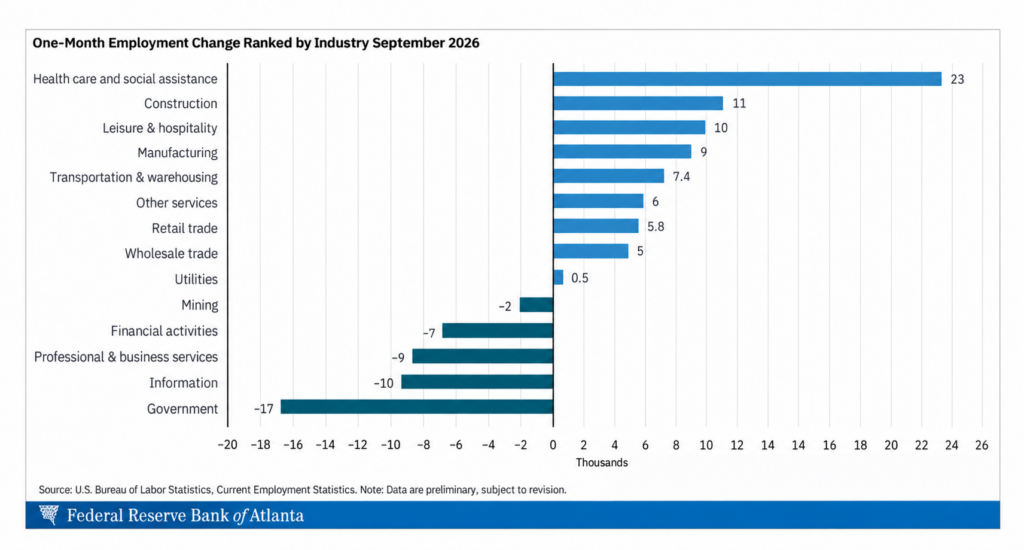
That is not a collapsing labor market. But it is an increasingly narrow one.
The Consumer Has Less Room for Error
That brings us to the question at the center of our new Q4 Look Ahead: Will the consumer hold?
So far, the answer is yes.
But it is becoming a more qualified yes.
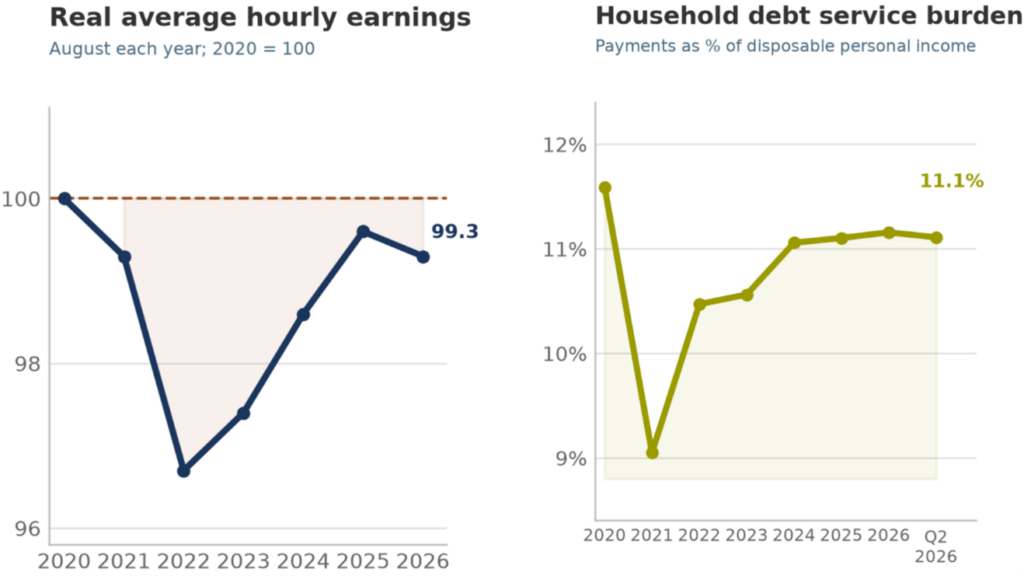
Real wages remain slightly below their August 2020 level. Household debt service has climbed, although at 11.1% of disposable income it remains below where it entered 2020.
Consumers still have income. They still have jobs. They are still spending.
What they increasingly lack is a large margin for error.
That distinction matters. I’m less interested in whether September created 29,000 jobs or 90,000 jobs than in whether weakening employment eventually changes consumer behavior. The consumer represents too much of the U.S. economy to treat employment as an isolated statistic.
So far, spending has been remarkably resilient.
That resilience is one reason I’m not particularly interested in joining the recession prediction business just yet.
The Other Side of the Ledger
The labor market is only one part of what makes the current setup unusual.
Inflation is still uncomfortable, but it isn’t evenly distributed. Energy has been responsible for roughly 1.2 percentage points of the 3.4% headline CPI rate in our work, while core inflation has been considerably more contained.
At the same time, the price of money has fundamentally changed.
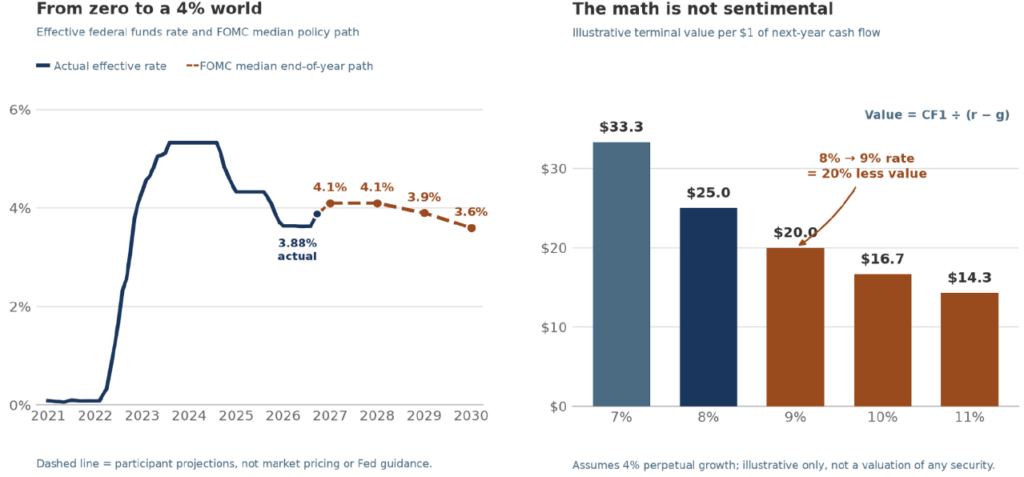
A roughly 4% policy rate isn’t historically extraordinary. It just feels extraordinary after investors spent more than a decade becoming accustomed to money costing almost nothing.
And the math at 4% is considerably less forgiving.
Future cash flows are worth less. Valuation starts to matter again. The Fed’s own September projections suggest investors shouldn’t automatically assume we are heading back to the zero-rate world anytime soon.
None of that means stocks have to fall.
It means companies need to produce.
And fortunately, they are.
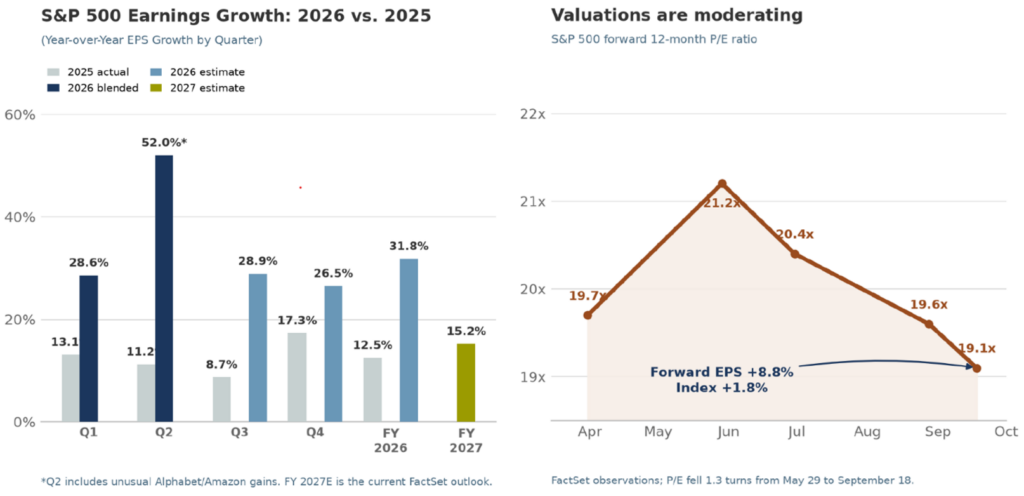
FactSet’s current estimate has S&P 500 earnings growing 31.8% in 2026. Profit margins remain unusually strong. At the same time, the forward P/E has fallen to about 19.1x as earnings estimates have risen faster than stock prices.
Nineteen times earnings isn’t cheap.
But there is an enormous difference between an expensive market supported primarily by hope and an expensive market supported by rapidly growing earnings.
That’s also why the AI discussion is beginning to change.
For the last couple of years, the obvious question was: Who is going to pay for all of this infrastructure?
We are beginning to get an answer. The four largest technology platforms are planning roughly $680 billion of infrastructure spending in 2026, while reported annualized revenue run rates at the two leading AI labs have gone from roughly $7 billion at the end of 2024 to more than $100 billion by mid-2026.
The bill is enormous, and somebody is starting to pay it.
What I’m Watching Now
That leaves us with an economy that isn’t nearly as easy to describe as the headlines suggest.
The labor market is slowing, but layoffs remain contained. The consumer is under pressure but hasn’t quit. Inflation is stubborn, but concentrated. Interest rates are higher, but companies are adapting. Valuations remain elevated, but earnings have been catching up. And outside the United States, earnings growth is broadening into markets that trade at considerably lower valuations.
That’s the setup for our Q4 2026 Look Ahead.
The question I’m asking isn’t whether everything is good.
Clearly it isn’t.
The better question is whether the parts of the economy absorbing the pressure can continue to bend without breaking.
For now, I think they can.
But the margin for error is getting smaller.
Watch our full Q4 2026 Look Ahead →
Read our full Q4 2026 Look Ahead →
If you have questions or comments, please let us know. You can contact us via X and Facebook, or you can e-mail Tim directly. For additional information, please visit our website.
Tim Phillips, CEO, Phillips & Company
Sources & Data References:
U.S. Bureau of Labor Statistics, Employment Situation — September 2026, October 2, 2026; Federal Reserve Bank of Atlanta, Labor Report First Look, September 2026; Federal Reserve Board, Summary of Economic Projections, September 16, 2026; Federal Reserve Board and FRED, Household Debt Service Payments and interest-rate data; U.S. Bureau of Labor Statistics, CPI-U and Real Earnings data; FactSet, Earnings Insight, August 28 and September 18, 2026; company filings and earnings releases from Alphabet, Amazon, Meta and Microsoft; Reuters and CNBC reporting on OpenAI and Anthropic revenue run rates; MSCI World and MSCI Emerging Markets fact sheets; Goldman Sachs Asset Management and RBC Wealth Management/FactSet. September payrolls increased by 29,000 and unemployment was 4.2%, according to the BLS.
The charts and data presented are sourced from a combination of public domain materials and licensed data providers. Their use is intended solely for educational and analytical commentary and falls within the scope of fair use. For a representative list of sources, please click here.
The material contained within (including any attachments or links) is for educational purposes only and is not intended to be relied upon as a forecast, research, or investment advice, nor should it be considered as a recommendation, offer, or solicitation for the purchase or sale of any security, or to adopt a specific investment strategy. The information contained herein is obtained from sources believed to be reliable, but its accuracy or completeness is not guaranteed. All opinions expressed are subject to change without notice. Investment decisions should be made based on an investor’s objective.