
Markets are often described as forward-looking, although there are moments when they seem more interested in defending yesterday’s assumptions than considering tomorrow’s evidence.
That may be where we are today.
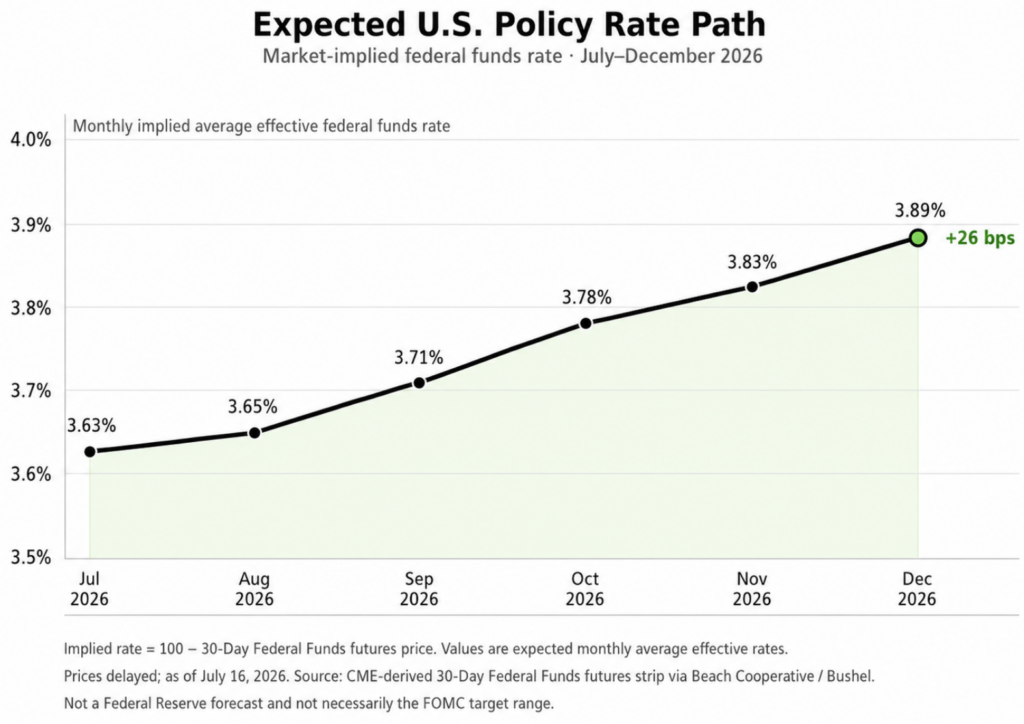
The interest-rate market is currently suggesting that monetary policy will become slightly more restrictive through the end of the year. At the same time, the latest economic data show inflation moderating, consumers continuing to spend and corporate earnings exceeding expectations.
Those conclusions do not fit together particularly well.
It is possible that the bond market is correctly anticipating another inflation problem. It is also possible that investors are placing too much weight on the recent past and not enough on what is beginning to change underneath the surface.
The futures market currently implies that the effective federal funds rate will rise from approximately 3.63% in July to 3.89% by December. That is not an enormous move, but it does reflect an important shift in expectations. Investors are no longer primarily debating how quickly the Federal Reserve will cut rates. They are beginning to consider whether policy may need to remain restrictive—or even become slightly more restrictive—for longer.
There are reasonable arguments behind that view. Economic growth has remained resilient, the labor market has not weakened materially, and some areas of inflation remain stubborn. The Federal Reserve also has little incentive to declare victory prematurely after spending several years trying to restore its credibility.
Still, the latest inflation data make the expected rate path somewhat difficult to reconcile.
Core inflation declined to 2.6% year over year in June, below the 2.8% estimate, while the monthly reading was essentially flat. One report does not establish a trend, and inflation is not yet back to the Federal Reserve’s target. But this was not simply a good headline number produced by one unusually weak category.
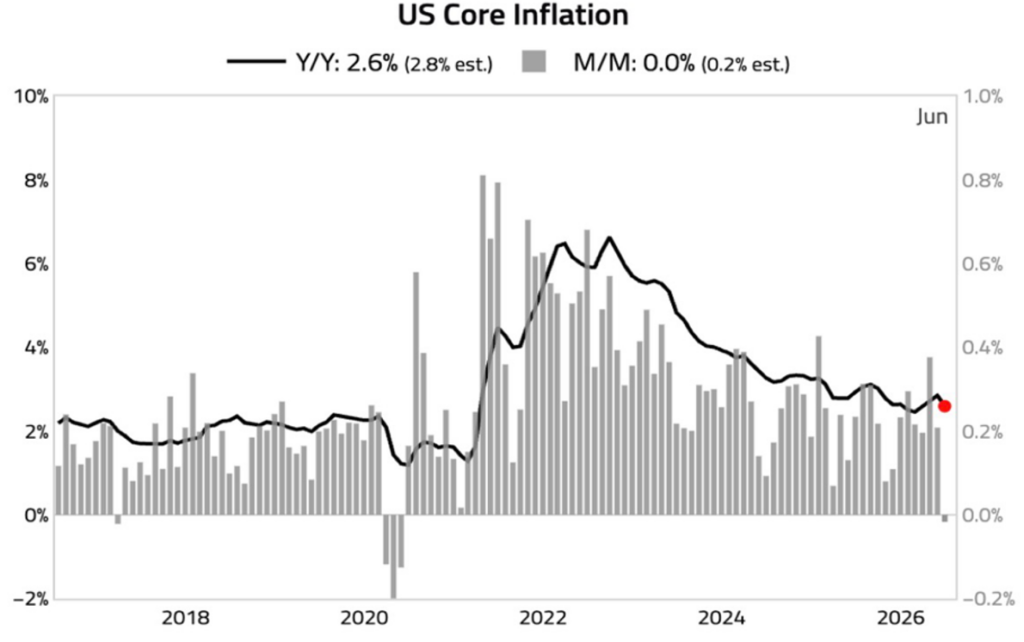
The improvement was fairly broad.
Several of the categories that created the greatest frustration for households over the past few years are now moving in the right direction. Motor vehicle insurance declined sharply during the month. Used vehicle prices, transportation services, apparel and medical care services also fell. Shelter inflation remained positive, but the pace continues to moderate.
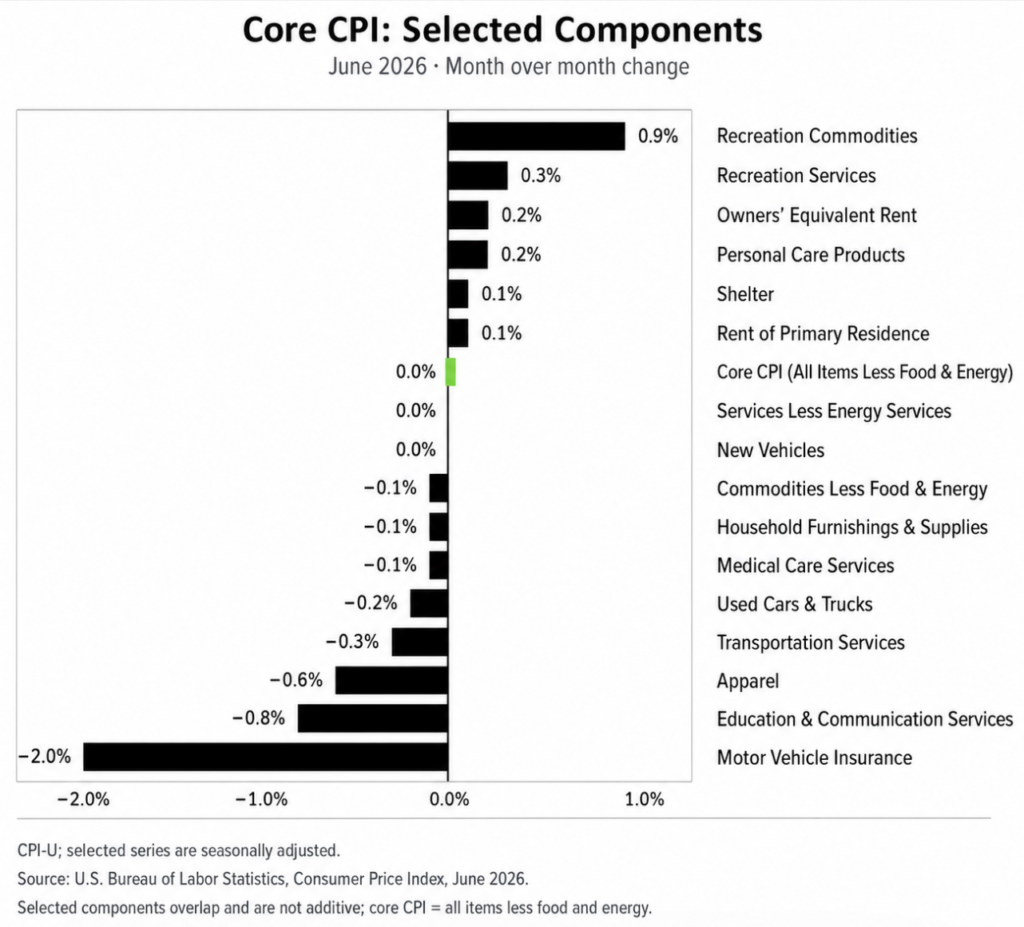
There were still areas of pressure. Recreation commodities increased 0.9%, and recreation services, personal care products and owners’ equivalent rent also rose. Inflation has not disappeared. It has simply become more concentrated, which is very different from the environment investors faced in 2021 and 2022, when nearly everything seemed to rise at once.
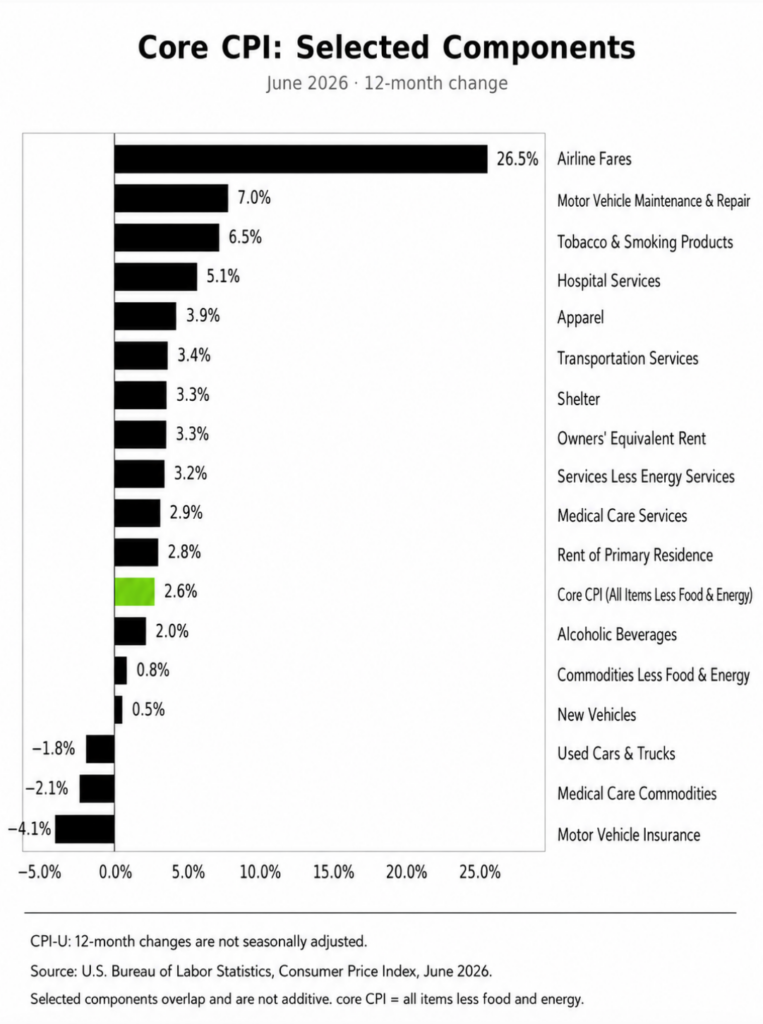
The year-over-year data make that distinction even clearer. Airline fares are up sharply, motor vehicle repairs remain expensive and hospital services continue to rise faster than the overall index. Shelter and owners’ equivalent rent are still running above core inflation as well.
At the same time, used vehicles, medical care commodities and motor vehicle insurance are now declining from a year ago. Goods inflation is largely contained, and core inflation itself has moved down to 2.6%.
This is not a perfect inflation report, but it is difficult to describe it as evidence that another round of monetary tightening is inevitable.
The more interesting part of the current environment is that inflation is cooling without a corresponding collapse in consumer activity.
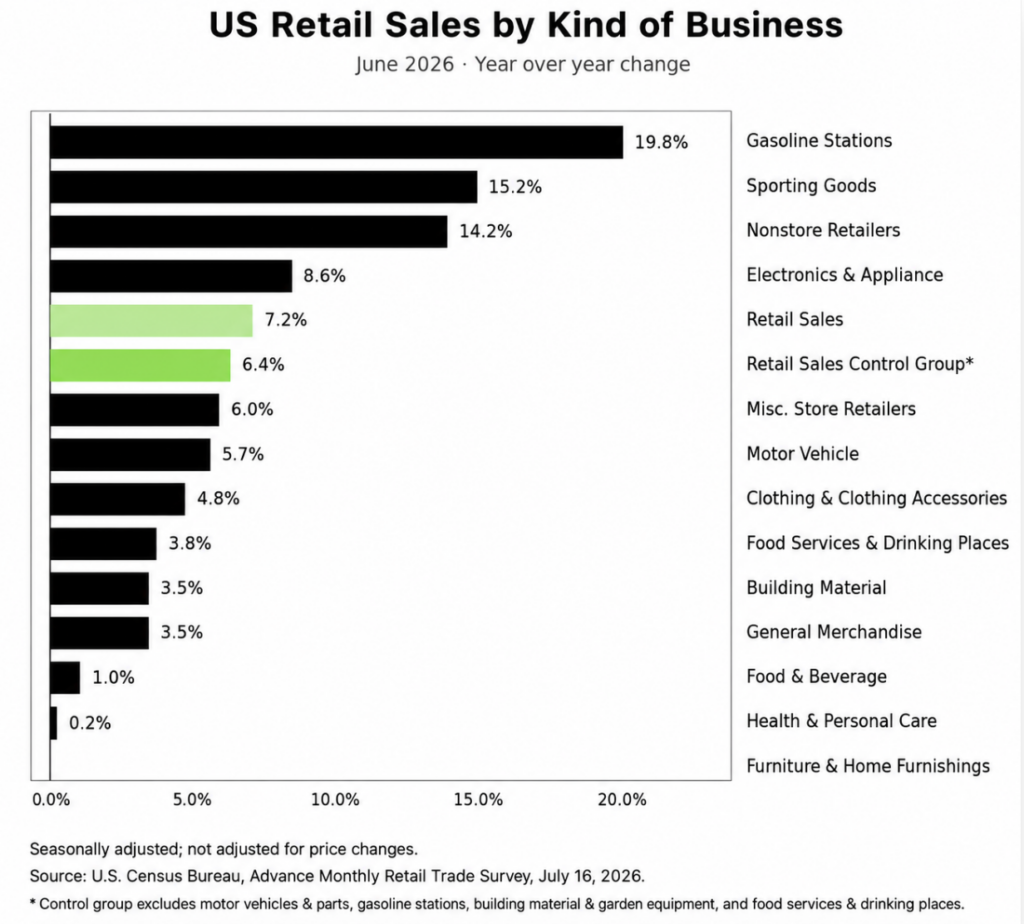
Retail sales increased 7.2% from a year ago, while the control group rose 6.4%. Nonstore retailers were up more than 14%, sporting goods increased more than 15%, and electronics and appliance sales rose 8.6%.
Gasoline station sales were up nearly 20%, although that figure is influenced by prices and should not be treated as a pure measure of consumer demand. Even after accounting for that distortion, the broader message is fairly clear: consumers are still spending.
The mix of spending is changing. Furniture sales were flat, health and personal care sales barely increased, and some pandemic-era categories remain soft. Consumers are not buying everything indiscriminately. They are choosing where to spend, which is what healthy consumers usually do.
The monthly report supports the same conclusion. Retail sales increased only 0.2%, but the control group gained 0.5%. Nonstore retailers and motor vehicle sales both increased 1.9%, while sporting goods and electronics also posted solid gains.
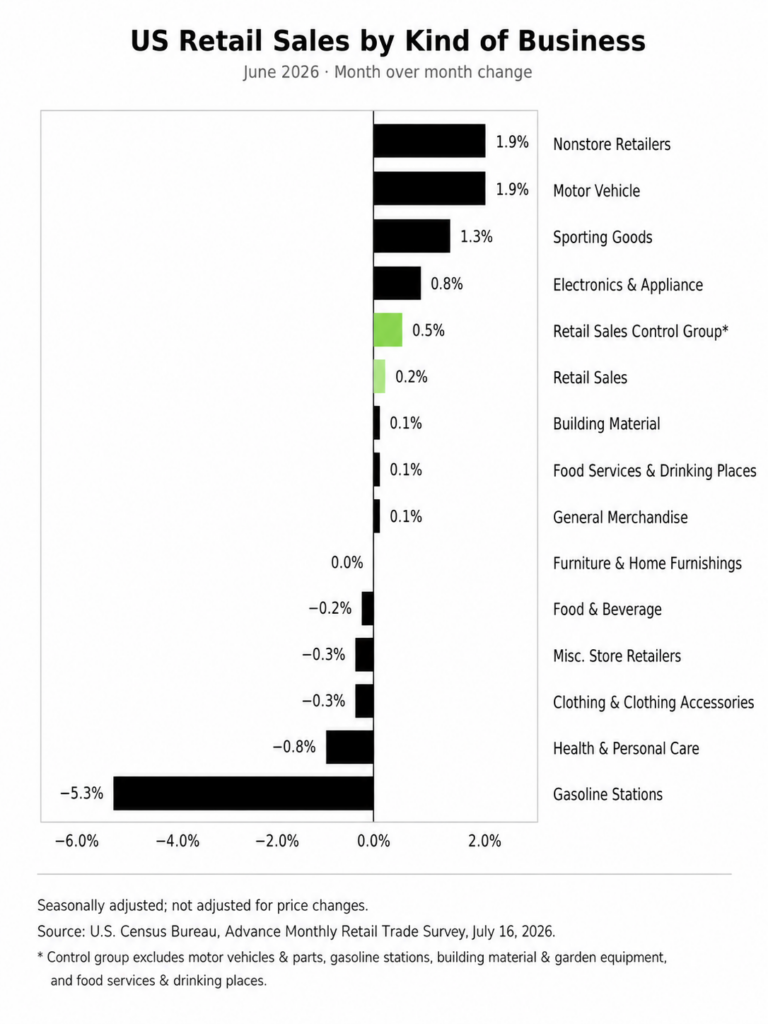
Gasoline station sales fell 5.3%, which held down the overall number. Lower gasoline spending, however, is not necessarily a sign of consumer weakness. In many cases, it simply means households are spending less to fill the tank and have more money available elsewhere.
That distinction is easy to miss in the headline.
A resilient consumer does not guarantee strong equity returns, but it provides a favorable backdrop for revenue growth. So far, corporate earnings are confirming that point.
The largest companies continue to produce exceptional results. Earnings for the Magnificent Seven increased more than 63% in the first quarter and are expected to grow approximately 31% in both the second and third quarters.
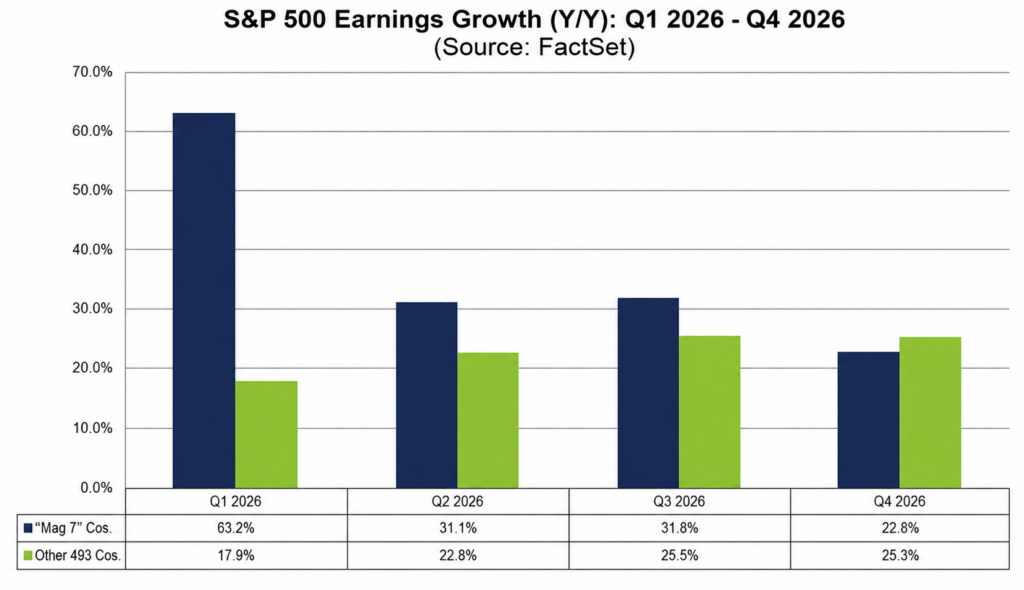
That performance deserves attention. These companies are not leading the market simply because investors have become irrationally enthusiastic about artificial intelligence. They are producing substantial earnings and cash-flow growth.
The more encouraging development, however, is that the rest of the market is beginning to participate. Earnings growth for the other 493 companies is expected to increase from 17.9% in the first quarter to roughly 25% by the fourth quarter.
For much of the last several years, investors worried that the market was being held together by a very small number of companies. That concern was reasonable. A market dependent on seven stocks is less durable than one supported by broad earnings growth.
The current estimates suggest that the earnings base may be widening.
The sector data show why.
Technology earnings are expected to grow more than 63%, which is remarkable but no longer surprising. Energy is projected to grow more than 120%, although that largely reflects comparison effects and the cyclical nature of the sector. Materials, financials, industrials, communication services and consumer discretionary companies are all expected to deliver positive earnings growth.
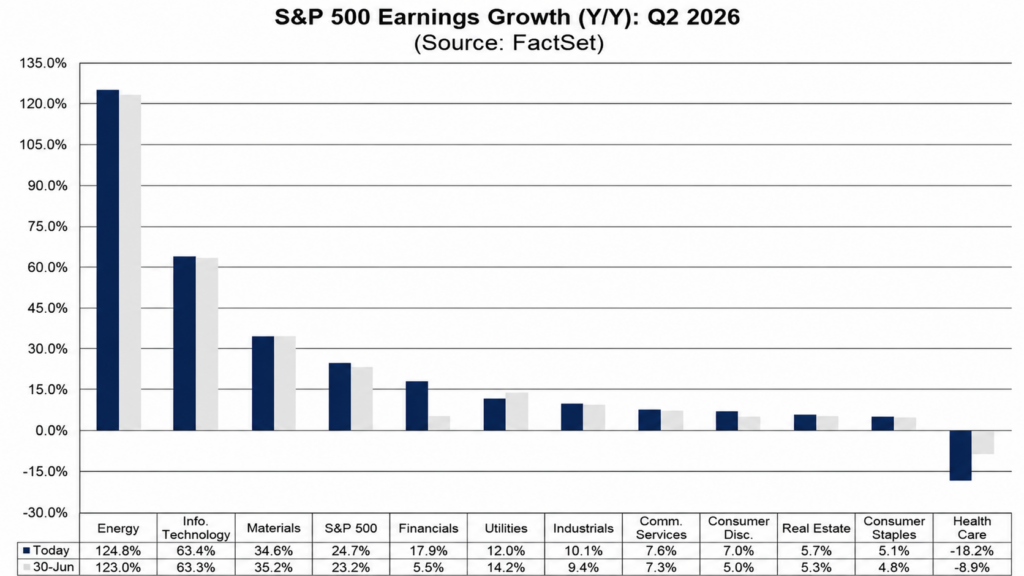
Health care remains the notable weakness, with earnings expected to decline sharply. Utilities have also seen estimates revised slightly lower since the end of June.
This is not universal strength, and it should not be presented that way. But it is broad enough to suggest that the earnings story is moving beyond the largest technology companies.
That brings us back to interest rates.
If consumers remain healthy, earnings continue to grow, and inflation continues to moderate, the Federal Reserve may eventually face a very different question. Rather than asking whether the economy can tolerate higher rates, policymakers may need to ask whether rates still need to remain this restrictive.
That does not mean rate cuts are imminent. The Federal Reserve will want more than one favorable inflation report, and economic resilience may allow it to remain patient. There are also risks that could interrupt the trend, including tariffs, energy prices, housing costs and renewed wage pressure.
But the setup is becoming more constructive.
The stock market ultimately reflects two things: the earnings companies produce and the value investors are willing to assign to those earnings. Stronger earnings support the first part of that equation. Lower interest rates can support the second by reducing the discount rate applied to future cash flows.
The most favorable outcome for investors would not be a recession that forces the Federal Reserve to cut rates. It would be continued economic growth, moderating inflation and a gradual reduction in policy restraint.
We are not there yet, but the latest data make that outcome more plausible.
The bond market is currently pricing a modest increase in rates through year-end. Perhaps that expectation will prove correct. Yet if inflation continues to move lower while the consumer and corporate earnings remain resilient, investors may eventually have to reconsider which market is telling the more accurate story.
For now, the evidence suggests the economy is stronger, inflation is cooler, and corporate earnings are better than many expected.
That is not a guarantee that equity prices move higher in a straight line. Markets rarely offer anything that convenient.
It is, however, a reasonably good place to begin.
If you have questions or comments, please let us know. You can contact us via X and Facebook, or you can e-mail Tim directly. For additional information, please visit our website.
Tim Phillips, CEO, Phillips & Company
Sources & Data References:
Sources: U.S. Bureau of Labor Statistics (Consumer Price Index, June 2026); U.S. Census Bureau (Advance Monthly Retail Sales Report, June 2026); FactSet Research Systems (S&P 500 Q2 2026 Earnings Insight and earnings estimates); CME Group 30-Day Federal Funds Futures (market-implied interest rate expectations); and Federal Reserve statements and economic projections. Opinions expressed are those of the author as of the publication date, are subject to change without notice, and should not be considered investment advice. Past performance is not indicative of future results, and all investing involves risk, including the potential loss of principal.
The charts and data presented are sourced from a combination of public domain materials and licensed data providers. Their use is intended solely for educational and analytical commentary and falls within the scope of fair use. For a representative list of sources, please click here.
The material contained within (including any attachments or links) is for educational purposes only and is not intended to be relied upon as a forecast, research, or investment advice, nor should it be considered as a recommendation, offer, or solicitation for the purchase or sale of any security, or to adopt a specific investment strategy. The information contained herein is obtained from sources believed to be reliable, but its accuracy or completeness is not guaranteed. All opinions expressed are subject to change without notice. Investment decisions should be made based on an investor’s objective.