
There is an old story about a man looking for his keys under a streetlight. His friend asks if that is where he lost them.
“No. I lost them across the street.”
“Then why are you looking here?”
“Because the light is better.”
I thought about that after the Fed raised rates this week.
Kevin Warsh has brought a somewhat different philosophy to the Federal Reserve. At Jackson Hole, he put it rather plainly: “money matters.” The phrase sounds almost quaint for a central banker in 2026, which may be exactly his point.
For years the Fed has become increasingly focused on forecasts, models, forward guidance, and carefully choreographed communication. Warsh wants a quieter Fed. He wants policymakers to pay closer attention to markets, financial conditions, and the quantity of money circulating through the economy. He also believes short-term interest rates should remain the Fed’s primary tool.
There is a lot about that approach that I like.
The inflation of the early 2020s should have reminded everyone that creating enormous amounts of money can eventually affect prices. Somehow we spent a few decades making monetary policy increasingly complicated while occasionally forgetting the first word in the name.
The question today is whether the same diagnosis applies.
The Economy Is Hardly Crawling
The Atlanta Fed’s GDPNow model currently estimates third-quarter real GDP growth at roughly 5.1%. It is a model, not an official GDP number, and it will change as additional data arrive. Still, it points to an economy growing at a pace that hardly suggests distress.
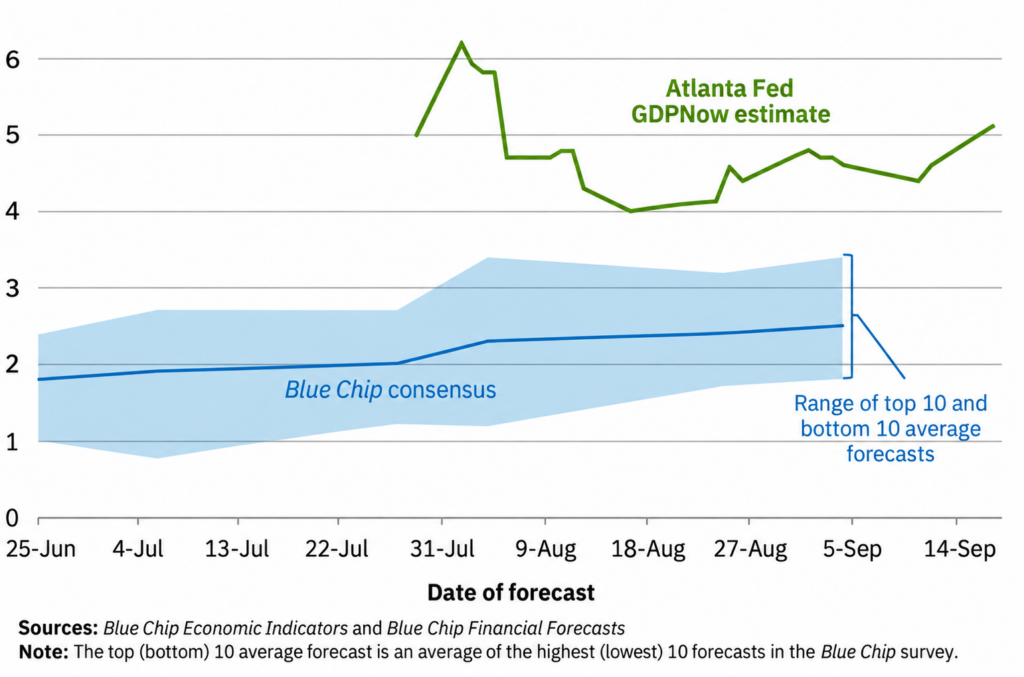
Warsh sees that strength too. After this week’s meeting he described an economy that had strengthened, with resilient spending, strong productivity and robust capital investment. At the same time, he said inflation remains the Fed’s central problem. The Fed responded by raising its policy rate to a range of 3.75% to 4.00%.
That sounds logical enough. Strong growth gives the Fed room to lean against inflation. But Warsh’s own monetary philosophy gives us another piece of evidence to consider.
If Money Matters, Let’s Look at the Money
During the pandemic, M2 money supply grew at a rate approaching 27%. We then got an inflation problem few Americans need reminding about. That was a pretty compelling advertisement for the idea that money matters.
Today looks quite different.
In July, M2 was growing 5.4% from a year earlier. Earlier this summer, the Federal Reserve itself described M2 growth as being broadly in line with the trends we saw during the 2010s.
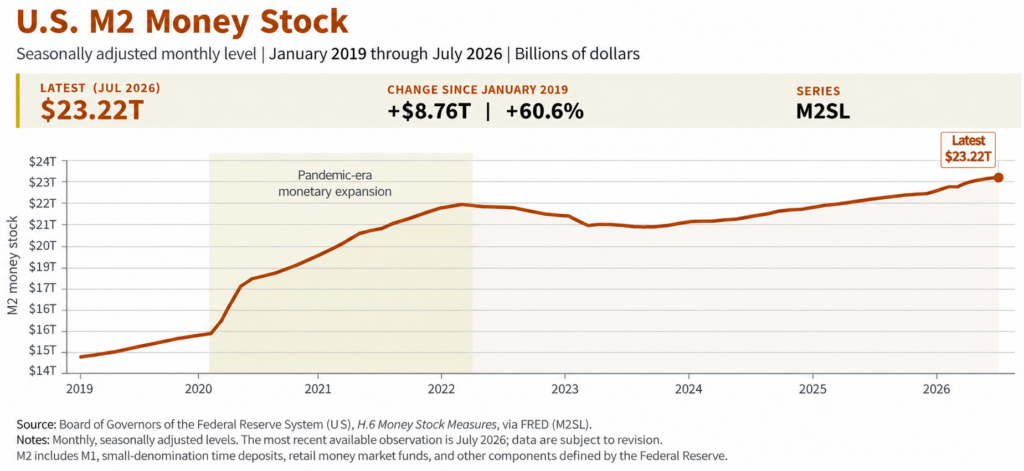
I would not make too much of one monetary measure. Warsh doesn’t either. Financial innovation has made the relationship between M2, velocity, and inflation much less predictable than it once was. That is one reason economists stopped treating money supply as a reliable steering wheel for monetary policy.
Still, if we are going to put money back into the discussion, the current reading deserves some attention.
We aren’t experiencing anything resembling the monetary explosion of 2020 and 2021. We are experiencing something much easier to see at the gas pump.
Follow the Inflation
August headline CPI was 3.4% from a year earlier. Energy prices were up 16.3%. Gasoline was up 27.4% and fuel oil was up 52%. Gasoline alone accounted for more than one-third of August’s monthly increase in CPI.
And energy doesn’t stay neatly inside the energy column.
It costs money to move food across the country. Airlines buy jet fuel and manufacturers use electricity. Fertilizer requires enormous amounts of energy. Data centers certainly don’t run on good intentions.
The pass-through is imperfect and difficult to measure. Shelter, labor, insurance, and services have their own inflation dynamics. I don’t want to turn every increase in the CPI report into an oil story.
Still, the current energy impulse is too large to dismiss.
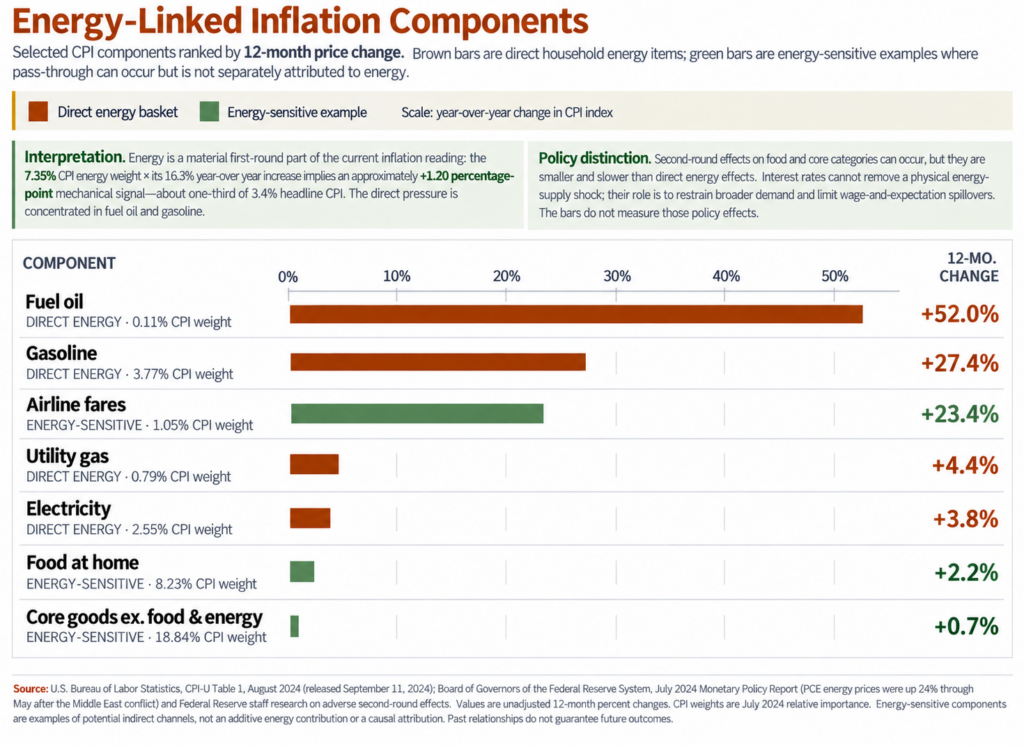
The Fed’s own July Monetary Policy Report acknowledged that inflation had risen partly because of supply shocks, including energy. That matters because monetary policy works mainly through demand.
Higher interest rates can discourage someone from buying a house. They can cause a company to postpone building a new factory and they can slow consumer borrowing and eventually hiring.
They have considerably less influence over the number of barrels of oil being produced.
That leaves the Fed in an awkward position.
Warsh’s argument is stronger than simply saying inflation is high so rates should rise.
His concern is that an energy shock can spread. Businesses pass along transportation costs. What begins as an oil problem can eventually become a broader monetary problem.
He has also been very clear that the 2% inflation target is fixed and that inflation should not simply be assumed to return to target on its own.
I understand that argument.
The experience of the 1970s is a pretty good warning against sitting around waiting for an energy shock to disappear.
My concern is with the amount of medicine required.
If money supply were expanding at 20% or 25%, consumer demand were exploding, and credit creation were running wild, a monetarist diagnosis would be fairly easy.
In the past several years money supply was running wild. That isn’t what the M2 data are showing today. It is more constrained.
Instead, we have an economy that appears to be growing very quickly, fairly ordinary money growth by recent historical standards, and a significant energy shock pushing headline inflation higher.
The Fed is responding with the one tool it has.
History doesn’t give us much comfort about our ability to know what’s happening in real time.
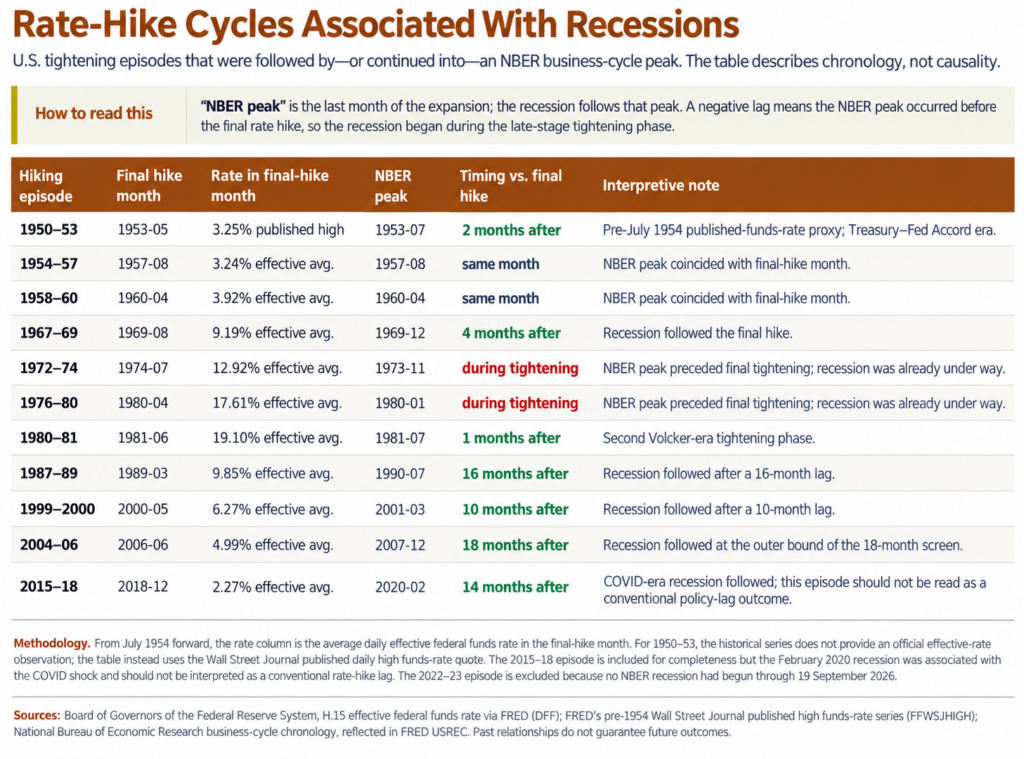
Rate hikes don’t mechanically create recessions. Wars, financial excesses, oil shocks, credit problems, and plain bad luck have all contributed to past downturns.
The problem is timing.
Monetary policy arrives with a lag. The Fed can tighten today while the economy still looks terrific. The effect on borrowing, investment, and employment can emerge months later.
By then the original inflation problem may look quite different.
That is why a 5% GDPNow estimate and a new tightening cycle deserve to be viewed together.
A strong economy gives the Fed room to raise rates. It also gives policymakers enough good news that the damage from those rates may not be apparent for some time.
Markets Have Seen This Movie Before
The record after initial rate hikes is mixed. Stocks have sometimes struggled early and subsequently recovered. The difference usually comes down to whether economic growth and earnings survive the tightening.
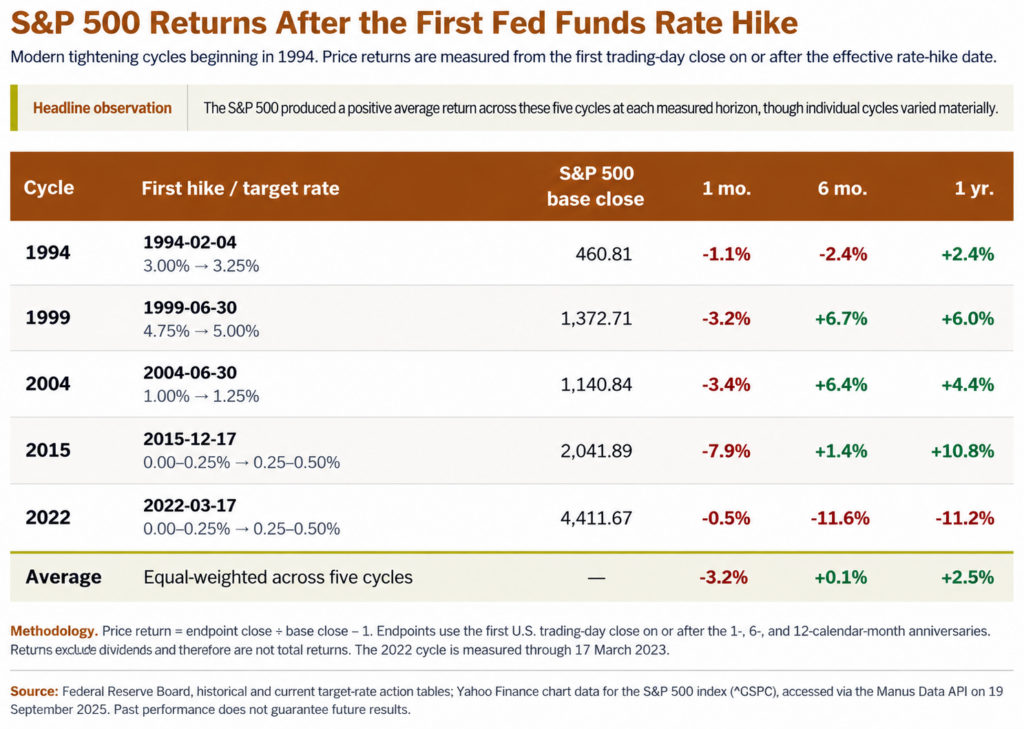
That is probably the right way to look at the current episode.
Higher rates make future corporate earnings less valuable today. Strong GDP growth can simultaneously produce more of those earnings.
For now we have both.
What I don’t want is for the Fed to keep raising rates until it finally solves that disagreement by weakening the earnings.
Warsh likes to say he is committed to a “discipline, not to a decision.” That is a sensible way to run a central bank. It also means the Fed needs to remain willing to change its diagnosis as the evidence changes.
His renewed attention to money may actually help.
The money supply warned us about inflation several years ago. Today it is giving us a much quieter signal. Energy is making considerably more noise.
That doesn’t make the inflation problem disappear. It does suggest we should be careful about treating every inflation problem as though it has the same cause.
The Fed can make money scarcer. It cannot make energy more plentiful.
There is a point where using the first to compensate for the second begins to impose a fairly large cost on everything else.
We aren’t necessarily there yet. I would rather not find out by driving a 5% economy into a recession. But I am keeping an eye on this dynamic as we consider distributing capital.
The light under Warsh’s new monetary streetlamp may actually be pretty good.
We should still make sure that’s where we dropped the keys.
If you have questions or comments, please let us know. You can contact us via X and Facebook, or you can e-mail Tim directly. For additional information, please visit our website.
Tim Phillips, CEO, Phillips & Company
Sources & Data References:
Federal Reserve Board, September 16, 2026 FOMC statement and Chairman Kevin Warsh’s August 28, 2026 Jackson Hole remarks; Federal Reserve Bank of Atlanta GDPNow, September 17, 2026; U.S. Bureau of Labor Statistics, August 2026 Consumer Price Index; Federal Reserve H.6 money stock data via FRED; and National Bureau of Economic Research business-cycle chronology. Warsh’s Jackson Hole speech provides the framework behind his renewed emphasis that “money matters,” while the Fed’s September decision raised the federal funds target range to 3.75%–4.00%. GDPNow estimated Q3 real GDP growth at 5.1%; August CPI showed headline inflation at 3.4%, energy inflation at 16.3%, gasoline at 27.4%, and core CPI at 2.4%; and M2 was growing 5.4% year over year in July.
The charts and data presented are sourced from a combination of public domain materials and licensed data providers. Their use is intended solely for educational and analytical commentary and falls within the scope of fair use. For a representative list of sources, please click here.
The material contained within (including any attachments or links) is for educational purposes only and is not intended to be relied upon as a forecast, research, or investment advice, nor should it be considered as a recommendation, offer, or solicitation for the purchase or sale of any security, or to adopt a specific investment strategy. The information contained herein is obtained from sources believed to be reliable, but its accuracy or completeness is not guaranteed. All opinions expressed are subject to change without notice. Investment decisions should be made based on an investor’s objective.