
Anyone who has built a house knows the first 90% of construction tends to go remarkably well. The framing goes up, the roof goes on, and every week brings visible progress. Then come the inspections, change orders, and the seemingly endless list of things nobody anticipated. The last 10% can consume an extraordinary amount of time and money.
Inflation may be following a similar script.
The Federal Reserve has made enormous progress bringing inflation down from its 2022 highs. But getting it from roughly 3% back to the Fed’s 2% target may prove considerably more difficult than the journey we’ve already traveled.
And the cost of that final percentage point could have important implications for interest rates, corporate profitability, and ultimately stock market valuations.
The interesting part is that corporate America may be better equipped to handle those costs than many investors appreciate.
Inflation: Close Isn’t Quite Good Enough
There is encouraging evidence that inflation is moderating. The August core Personal Consumption Expenditures Index, the Fed’s preferred inflation measure, increased 3.0% over the preceding 12 months. But the more recent three-month annualized pace was closer to 2.0%, and the Dallas Fed’s trimmed-mean inflation measure was running at 2.2%.
The direction is encouraging, even if the destination remains uncertain.
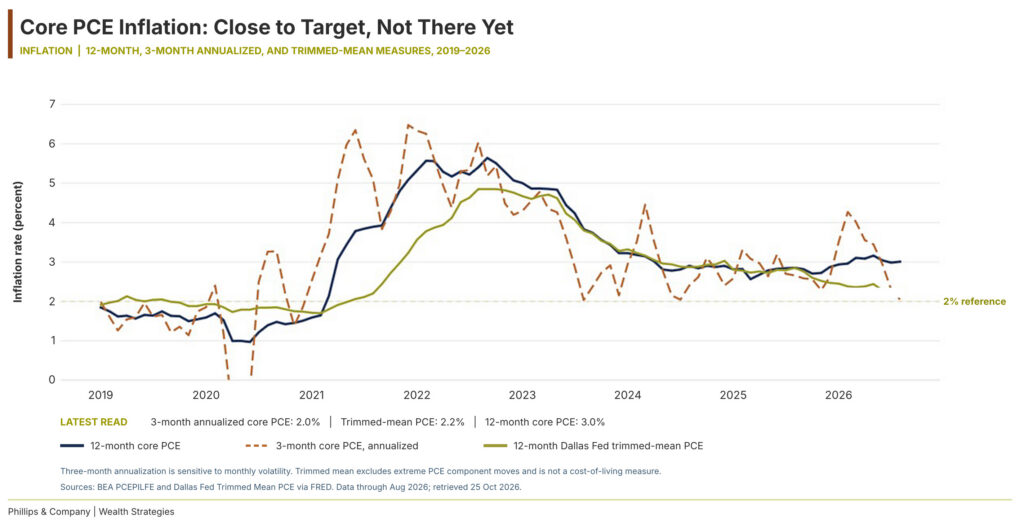
The challenge is that inflation doesn’t necessarily decline in a straight line. Energy, housing, healthcare, and labor costs all respond to different economic pressures. The Fed can influence demand, but it cannot produce more oil or immediately improve productivity.
That’s why getting inflation down another percentage point could prove more difficult than the relatively rapid improvement we’ve already experienced.
History provides an interesting perspective. An analysis of previous Federal Reserve tightening cycles suggests that the median reported increase in interest rates before inflation declined by one percentage point was approximately 205 basis points.
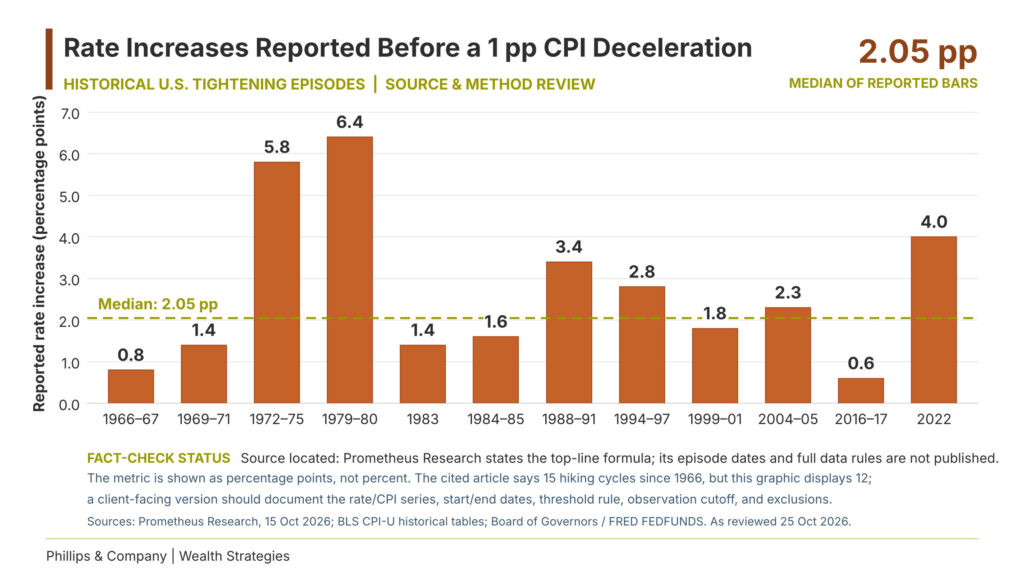
The range was substantial. Some episodes required fewer than 100 basis points of tightening, while others involved increases of more than 500 basis points.
I wouldn’t use that history to suggest the Fed needs another 200 basis points of rate increases. Economic conditions differ, and monetary policy operates with significant delays. The historical study also doesn’t establish that every decline in inflation was caused by higher rates.
But it does remind us that monetary restraint often needs to be more persistent than investors would prefer.
If inflation remains stubbornly above target, the Fed may face an uncomfortable decision: tolerate inflation somewhat above 2%, or maintain restrictive monetary policy at the risk of slowing economic activity.
Neither outcome is particularly appealing.
What Happens to Corporate Profits?
One of the more interesting relationships in economic history is what happens to corporate profitability after substantial monetary tightening.
Looking at nine historical tightening cycles in which the federal funds rate increased by at least 200 basis points, the median decline in the broad domestic corporate profit share was approximately 0.4 percentage points after one year and 1.8 percentage points after two years.
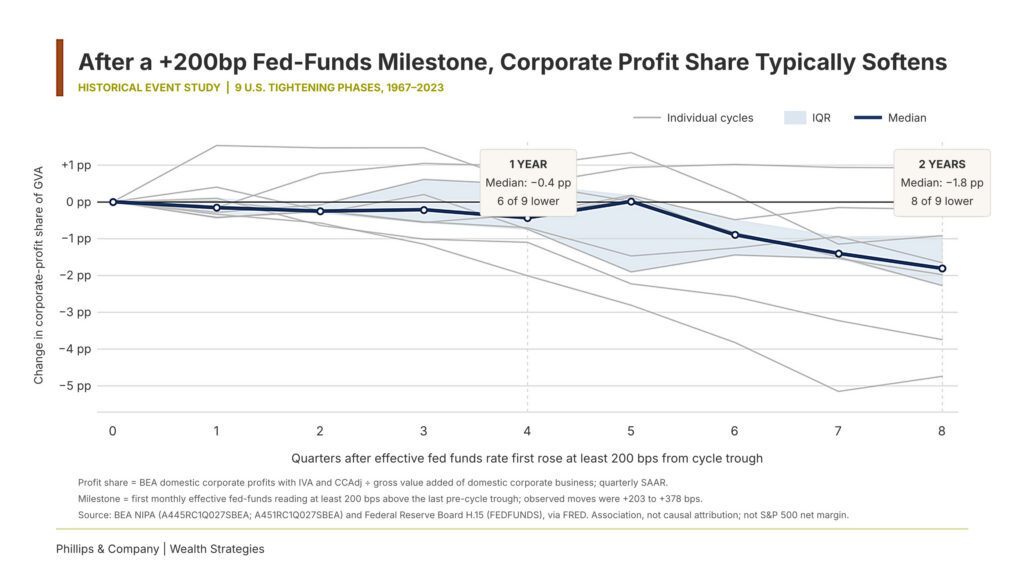
In eight of the nine cycles, the corporate profit share declined over the subsequent two years.
The logic is fairly straightforward. Higher interest rates increase financing costs, discourage some investment, and eventually restrain consumer demand. Companies have less flexibility to increase prices, particularly when customers become more sensitive to what they’re spending.
Eventually, at least some of the economic adjustment gets absorbed by corporate profits.
And the historical experience doesn’t tell us how much profitability would decline in today’s economy.
Corporate America Has an Enormous Cushion
This is where I think investors should resist the temptation to become overly pessimistic.
Corporate America is entering this period from a position of extraordinary profitability.
According to FactSet, the S&P 500’s net profit margin reached 17.0% in the second quarter of 2026, the highest level in its data series. The third-quarter estimate is 14.9%, still comfortably above the roughly 11% to 12% margins we saw during portions of 2022 and 2023.
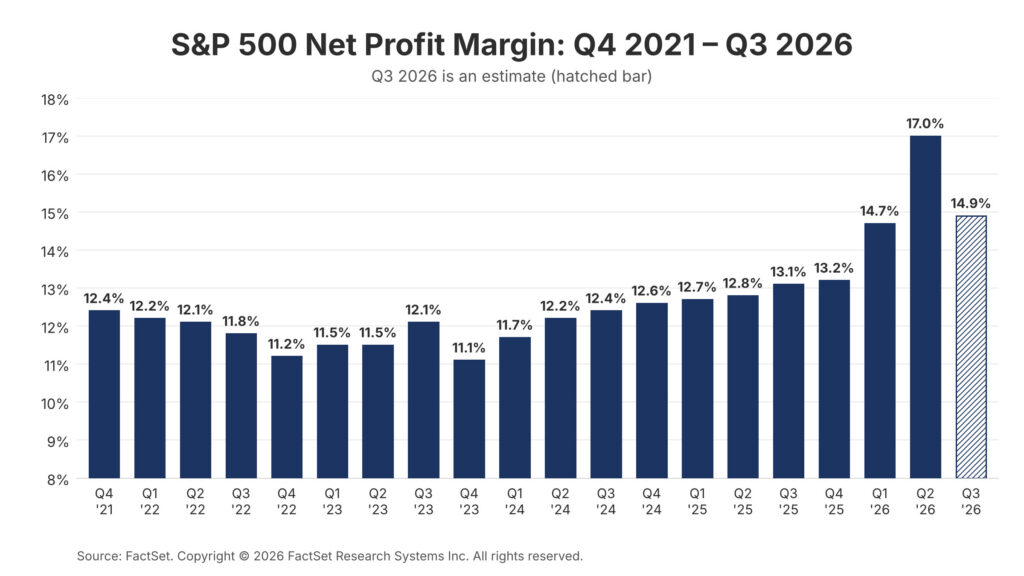
Think about what that means.
A company generating $100 in revenue and earning $17 after expenses has considerable capacity to absorb some higher financing costs, labor inflation, or weaker pricing before profitability returns to historically more ordinary levels.
Margins could compress from 17% to 15%, and the company would still be earning $15 on every $100 of revenue. That would represent a meaningful decline in profitability, but hardly a collapse in the underlying business.
There’s an additional consideration. Earnings are a function of both revenues and margins. If revenues continue growing, companies can experience declining margins while still reporting higher absolute earnings.
For example, a company with $100 in revenue and a 17% margin produces $17 in earnings. If revenue grows 10% and its margin falls to 16%, earnings would actually increase to $17.60.
That’s the distinction I think matters.
Margin compression doesn’t necessarily mean declining earnings. It may simply mean earnings grow more slowly.
And given where margins stand today, corporate America has substantial room to absorb some economic pressure without undermining its long-term earnings power.
Of course, the cushion isn’t evenly distributed. Highly leveraged companies, lower-margin businesses, and industries facing weak demand are more vulnerable than companies with strong balance sheets and durable pricing power.
Still, the aggregate picture is considerably more encouraging than the historical relationship between interest rates and profits might initially suggest.
Earnings Are Still Remarkably Strong
The third-quarter earnings season reinforces the point.
According to FactSet’s October 23rd report, the S&P 500 is reporting blended year-over-year earnings growth of 29.5%. If that figure holds, it would represent the third consecutive quarter of earnings growth above 25%.
Those are extraordinary numbers.
Technology, energy, and communication services have made substantial contributions to the improvement, with companies such as Micron, Nvidia, and Broadcom accounting for a disproportionate share.
There is some concentration risk in those numbers. A relatively small number of companies are generating a substantial portion of total earnings growth, and their ability to sustain that performance matters enormously.
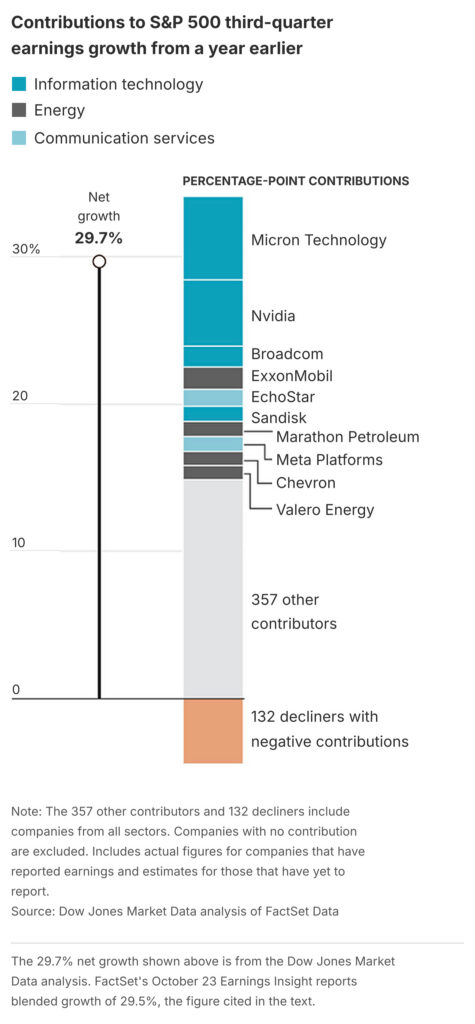
But we shouldn’t overlook the broader picture. Ten of the 11 S&P 500 sectors are reporting positive earnings growth. This isn’t an earnings recovery confined exclusively to a handful of technology companies.
There’s also an important distinction between earnings growth and earnings expectations.
Investors don’t simply reward companies for generating more profits. They reward companies for generating more profits than expected.
If earnings growth moderates from 29% to 15%, that would still represent excellent corporate performance. But if investors are expecting 25%, the stock market could react negatively.
That’s not an indictment of corporate profitability. It’s simply the way markets discount expectations.
Valuations Are More Reasonable Than You Might Think
Now we arrive at what I consider one of the more encouraging developments for investors.
Despite exceptional earnings, the S&P 500 is currently trading at approximately 18.7 times forward 12-month earnings, according to FactSet.
That’s below the five-year average of 19.8 times and the 10-year average of 19.1 times.
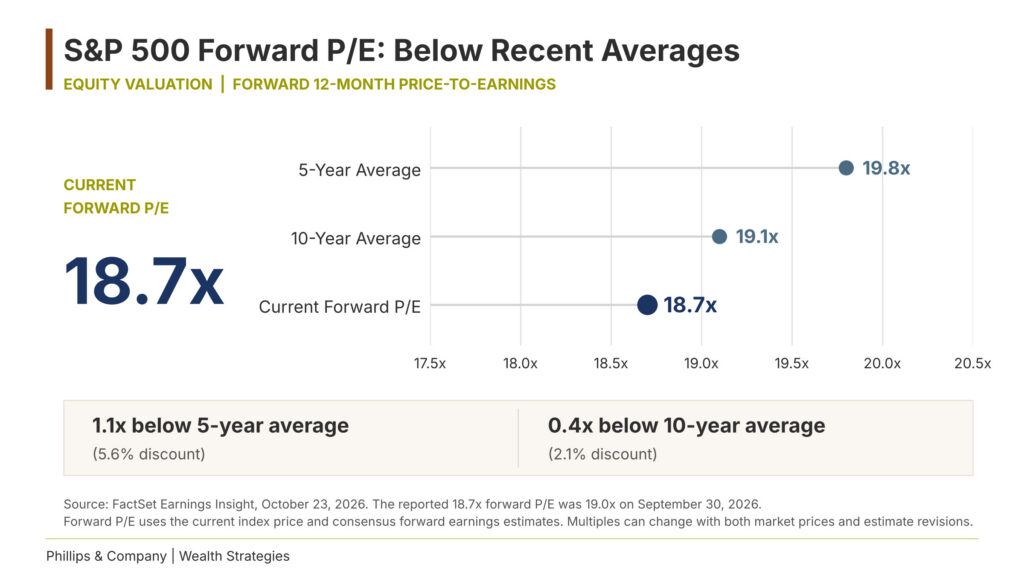
In other words, the market is trading at a discount of approximately 5.6% to its five-year average valuation and 2.1% to its 10-year average.
For all the concerns surrounding inflation, interest rates, and the concentration of earnings growth, valuations are more reasonable than they were earlier in the year.
Part of that improvement reflects the strength of corporate earnings. As earnings estimates have increased, the market has become less expensive relative to its expected profitability.
That doesn’t automatically make stocks cheap. Interest rates matter when determining what investors should be willing to pay for future earnings. A market trading at 18.7 times earnings with Treasury yields near 4% presents a different valuation proposition from one trading at the same multiple when Treasury yields are 2%.
And the denominator matters. If earnings estimates prove overly optimistic, an apparently reasonable multiple can change quickly.
But I’d argue there’s a meaningful difference between a market trading above historical averages with fragile earnings and one trading below those averages while companies are generating extraordinary levels of profitability.
We appear to be closer to the latter.
Can the Fed Have Its Cake and Eat It Too?
The ideal outcome would be continued disinflation accompanied by strong corporate earnings and improving productivity.
It’s certainly possible.
Technology investment, automation, and artificial intelligence may allow companies to generate more output without corresponding increases in labor or operating costs. Those productivity gains could allow margins to remain elevated even as inflation moderates.
But there are reasons to be cautious.
If inflation proves stubborn, the Fed may need to maintain higher interest rates for longer than investors currently anticipate. That could gradually erode corporate pricing power and eventually produce slower earnings growth.
What’s interesting is that the economy doesn’t necessarily need to experience a recession for this adjustment to occur. It may simply take a period of more modest revenue growth, slightly lower profit margins, and more disciplined business investment.
That would hardly be a catastrophe.
In fact, a modest normalization of corporate profitability could be part of a healthy economic adjustment, particularly if it allows inflation to return toward target without a substantial increase in unemployment.
And with corporate margins beginning from historically elevated levels, there’s considerably more room for adjustment than there would be if profitability were already depressed.
My Take for Investors
I remain constructive on the long-term outlook for equities.
We have exceptionally strong corporate earnings, historically elevated profit margins, and an S&P 500 trading below its five- and 10-year average forward earnings multiples. Those are not the ingredients I would ordinarily associate with an excessively expensive equity market.
But I also think investors need to be realistic about the potential cost of getting inflation back to 2%.
Interest rates may remain elevated longer than anticipated. Corporate margins could moderate. Earnings growth could slow from extraordinary levels to something more ordinary.
None of those developments necessarily represents a fundamental problem for long-term equity investors.
What concerns me more is the possibility that investors interpret a return to normal profitability as evidence that something is seriously wrong.
There is a difference between a business earning less than it did at the peak of an unusually favorable period and a business experiencing permanent deterioration in its underlying economics.
I suspect we’ll spend considerable time over the next year distinguishing between the two.
The market may experience bouts of volatility as interest-rate expectations, profit margins, and earnings forecasts adjust. That’s part of the investment experience, not necessarily a reason to abandon equities.
The important thing is to maintain a time horizon that extends well beyond the next Federal Reserve meeting or quarterly earnings announcement.
Corporate America has an extraordinary amount of profitability to work with. Some of that profitability may ultimately be the price of bringing inflation under control.
The question isn’t whether corporate profits can afford to give a little back. In many cases, they clearly can. The more interesting question is how much investors have already assumed they won’t have to.
If you have questions or comments, please let us know. You can contact us via X and Facebook, or you can e-mail Tim directly. For additional information, please visit our website.
Tim Phillips, CEO, Phillips & Company
Sources & Data References:
Sources: FactSet Earnings Insight, October 23, 2026; FactSet S&P 500 net profit margin data; Bureau of Economic Analysis, August 2026 Personal Consumption Expenditures; Dallas Federal Reserve Trimmed Mean PCE; Federal Reserve/FRED historical monetary-policy and corporate-profit-share data; Prometheus Research historical tightening analysis, October 15, 2026; Dow Jones Market Data analysis of FactSet earnings data. Historical relationships do not establish causation or predict future outcomes.
The charts and data presented are sourced from a combination of public domain materials and licensed data providers. Their use is intended solely for educational and analytical commentary and falls within the scope of fair use. For a representative list of sources, please click here.
The material contained within (including any attachments or links) is for educational purposes only and is not intended to be relied upon as a forecast, research, or investment advice, nor should it be considered as a recommendation, offer, or solicitation for the purchase or sale of any security, or to adopt a specific investment strategy. The information contained herein is obtained from sources believed to be reliable, but its accuracy or completeness is not guaranteed. All opinions expressed are subject to change without notice. Investment decisions should be made based on an investor’s objective.