
There is an old story about a man who checks the weather forecast every morning before leaving home. One day, the forecast calls for rain, so he carries an umbrella under a perfectly blue sky. The next day, it predicts sunshine, and he gets soaked walking to work.
Eventually, he learns the useful lesson: forecasts matter, but it is still worth looking out the window.
That feels like a reasonable way to view the economy today.
For several years, investors have lived almost entirely by the economic forecast. Every inflation report became a referendum on interest rates. Every jobs report was interpreted through the Federal Reserve. Every press conference produced an elaborate debate over a single adjective.
Last week gave us another Fed meeting, another inflation report, and another GDP report. But when we look out the window, the picture is more interesting than the forecast alone suggests.
The Fed is cautious as inflation remains too high. Yet the private economy is still growing, consumers are still spending, and businesses are making enormous investments in technology and productivity.
That is not a perfect economy, but it’s also not an economy waiting around for the Fed’s permission to expand.
The Fed has a reason to remain cautious
The Federal Reserve held its target rate at 3.50%–3.75% last week. That was hardly a surprise. The more important message was that the Fed does not appear convinced inflation is safely returning to its 2% objective.
Core PCE inflation was 3.3% in June. That was slightly lower than May, but it is still meaningfully above target. The Fed has already lowered rates from their peak, yet inflation has stopped making the clean, uninterrupted progress investors hoped to see.
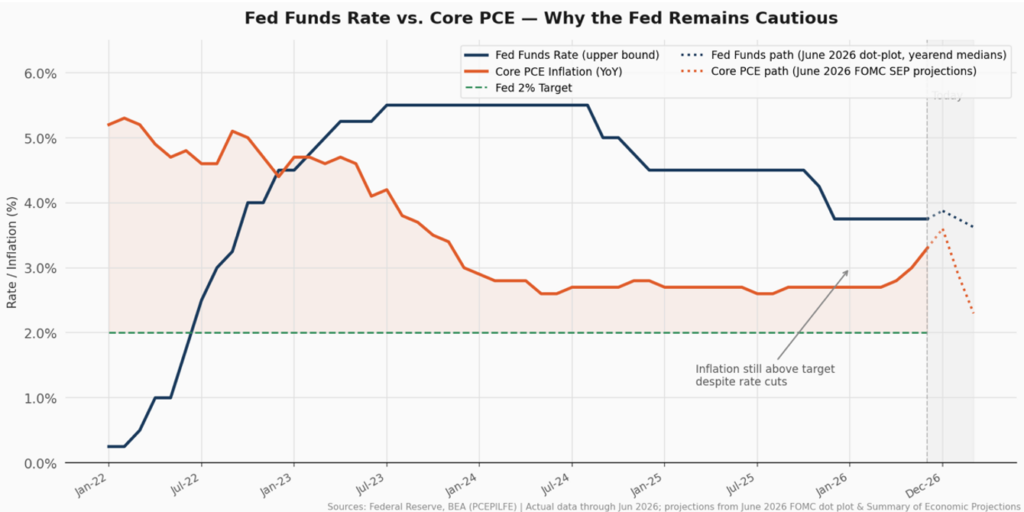
The chart tells the story. Monetary policy is no longer becoming progressively tighter, but the gap between inflation and the Fed’s target remains stubborn.
This leaves the Fed in an uncomfortable position. Rates are restrictive enough to create pressure in housing, lending, and other interest-sensitive parts of the economy. At the same time, growth and employment have not weakened enough to force the Fed’s hand.
The Fed can afford to wait. More importantly, it probably believes waiting is the least costly choice.
There is also a small irony here. Investors spent much of the last few years waiting for rate cuts to rescue the economy and markets. Rates have now come down from their peak, but the economy never required much rescuing.
The headline GDP number missed the better story
Real GDP increased at a 1.5% annual rate during the second quarter, down from 2.1% in the first quarter. Read only that number and the economy appears to be losing momentum.
But GDP is an accounting identity, not a medical diagnosis. Trade, inventories, and government spending can push the headline around considerably from one quarter to another. A better measure of the underlying private economy is real final sales to private domestic purchasers—the combined spending of consumers and private businesses.
That measure increased at a 3.9% annual rate during the quarter.
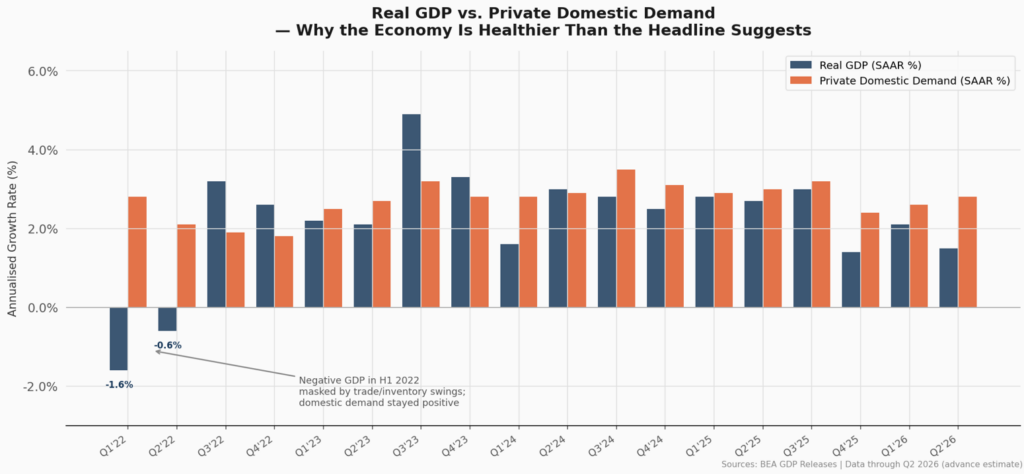
That is a very different picture.
Headline GDP slowed, but the economic activity closest to households and businesses accelerated. We have seen this movie before. GDP briefly contracted during the first half of 2022, prompting an intense debate about whether the country was already in recession. Private demand remained positive, employment continued growing, and the recession never arrived.
The lesson is not that GDP should be ignored. It is that a single headline can conceal more than it reveals.
Today’s economy has weak spots. Housing remains constrained by affordability. Lower-income consumers face more pressure than aggregate spending numbers suggest. Certain industries are clearly slowing. But the broad private economy continues to behave more like an expansion than a contraction.
The consumer continues to spend
Consumers remain the most important part of the U.S. economy, and they are still spending. Real consumer spending rose 0.4% in June, while real disposable personal income increased 0.3%. Over a longer period, consumer spending has grown considerably faster than real disposable income.
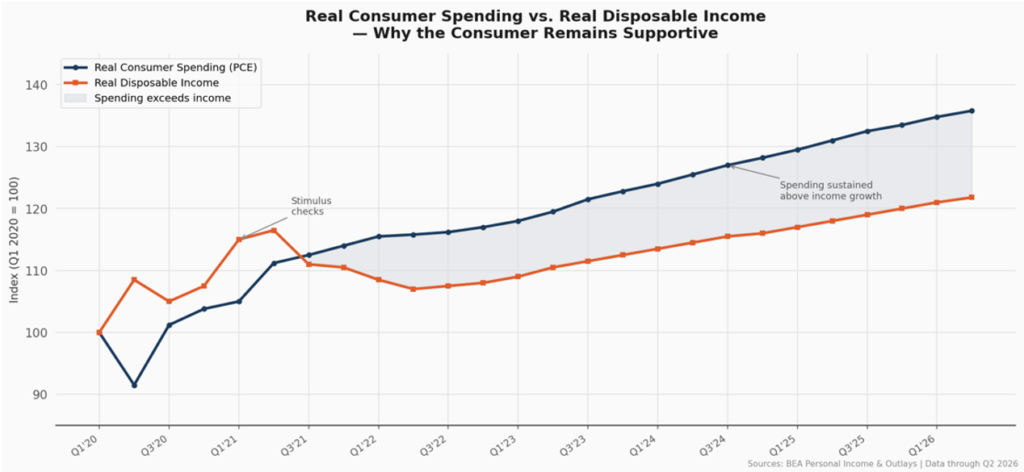
There are two ways to interpret this.
The optimistic view is that consumers remain employed, wages are growing, and household balance sheets are strong enough to support continued spending. That interpretation is supported by the fact that the economy has absorbed higher prices and higher interest rates without a major collapse in consumption.
The more cautious view is that spending cannot indefinitely grow faster than the income available to support it.
Both things can be true. Consumers are not behaving as though a recession is imminent. But their margin for error is getting smaller. That distinction matters, and we need to watch this in the coming quarter.
The savings cushion is becoming thin
The personal saving rate fell to 2.7% in June, well below both its pre-pandemic average and its average following the financial crisis.
This is the cautionary note in an otherwise constructive economic picture.
Consumers continue to support growth, but they are doing so with less income left over after spending. Some of this may reflect confidence. Households with rising wages, appreciating homes, and investment gains may simply feel comfortable saving less.
But it also means the economy has a smaller shock absorber.
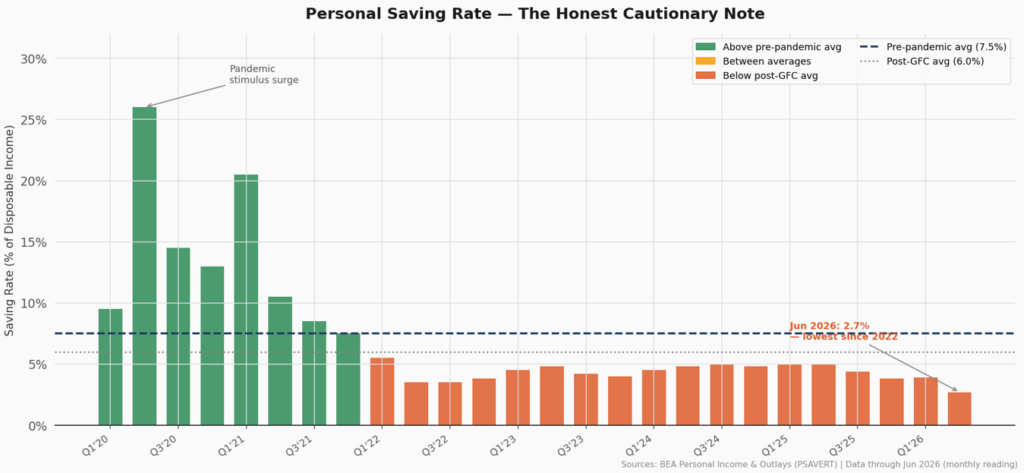
A renewed rise in inflation, a meaningful weakening in employment, or another increase in borrowing costs would be harder for households to absorb today than it was when savings were more plentiful.
The saving rate does not tell us that consumer spending is about to collapse. It tells us that continued income and employment growth are becoming more important. That is a meaningful difference.
The economy is investing in what comes next
The other major story is happening inside business investment.
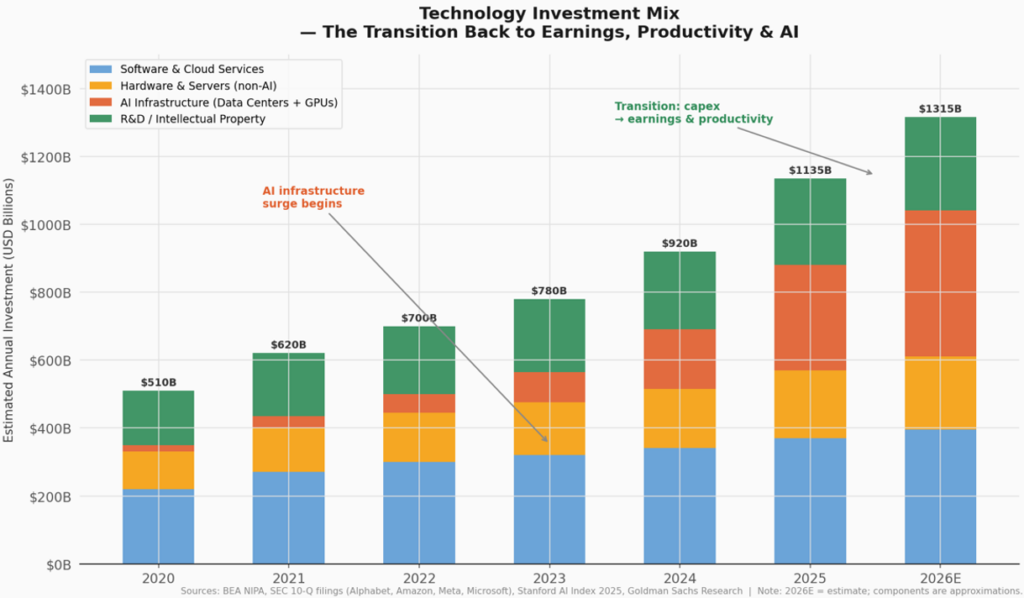
Capital is increasingly moving toward software, computing infrastructure, data centers, research, and intellectual property. The sheer scale of spending connected to artificial intelligence has become one of the defining features of this economic cycle.
It is easy to look at these numbers and conclude that companies are spending too much. Perhaps some are. Every major investment cycle eventually produces waste. Railroads were overbuilt. Fiber-optic networks were overbuilt. The internet produced hundreds of companies whose business plans did not survive contact with reality.
But waste and progress frequently arrive together.
The country may ultimately build too many data centers in the wrong places, pay too much for certain assets or discover that some AI applications are far less valuable than advertised. That would not mean the investment cycle itself was a mistake.
The better question is whether this spending eventually creates enough productivity and earnings to justify the capital being committed.
That question is now moving from theory to financial statements.
The first phase of the AI cycle was about access to computing power. The next phase will be about who can convert that computing power into lower costs, faster product development, higher revenue, and better margins.
Wall Street is no longer satisfied with hearing that a company has an AI strategy. It increasingly wants to see the return.
That is healthy.
The Fed is becoming less important—and that may be good news
For years, markets have been dominated by monetary policy. Investors watched the Fed because the cost of money was changing rapidly and valuations had to adjust with it.
That era may be giving way to something more normal.
The Fed remains important. Inflation remains too high. The consumer’s savings cushion deserves attention. There are legitimate risks beneath the aggregate data.
But the economy is still expanding, underlying private demand is healthy, and businesses are investing heavily in future productivity. Corporate earnings—and the return companies generate from that investment—are becoming more important than trying to predict the next quarter-point move in interest rates.
The weather forecast still matters. But every now and then, it is worth looking out the window.
If you have questions or comments, please let us know. You can contact us via X and Facebook, or you can e-mail Tim directly. For additional information, please visit our website.
Tim Phillips, CEO, Phillips & Company
Sources & Data References:
Sources: Federal Reserve (July 29, 2026 FOMC Statement and Summary of Economic Projections); U.S. Bureau of Economic Analysis (Advance Estimate of Q2 2026 GDP; Personal Income and Outlays, June 2026; Core PCE Price Index); Bureau of Labor Statistics; FRED Economic Data (Federal Reserve Bank of St. Louis); U.S. Department of the Treasury; FactSet Earnings Insight; Bloomberg; Goldman Sachs Global Investment Research; J.P. Morgan Economic Research; Morgan Stanley Research.
The charts and data presented are sourced from a combination of public domain materials and licensed data providers. Their use is intended solely for educational and analytical commentary and falls within the scope of fair use. For a representative list of sources, please click here.
The material contained within (including any attachments or links) is for educational purposes only and is not intended to be relied upon as a forecast, research, or investment advice, nor should it be considered as a recommendation, offer, or solicitation for the purchase or sale of any security, or to adopt a specific investment strategy. The information contained herein is obtained from sources believed to be reliable, but its accuracy or completeness is not guaranteed. All opinions expressed are subject to change without notice. Investment decisions should be made based on an investor’s objective.