
Wall Street has developed a serious case of anxiety about artificial intelligence. After spending much of the past two years celebrating the extraordinary amount of money flowing into AI, investors are now questioning the very investments they were so enthusiastic about financing.
Some of those questions are reasonable. Others seem to reflect a market that has become increasingly uncomfortable with its own expectations.
The dramatic events surrounding Nvidia and Jensen Huang have added another layer of uncertainty. Huang’s departure, followed by his reinstatement as CEO just eleven days later, provided Wall Street with a reminder of how much confidence in the AI industry rests on a relatively small number of companies and individuals.
His return should help restore some confidence. Huang has been the central figure behind Nvidia’s extraordinary rise and remains one of the most influential executives in technology. His leadership, relationships and vision have played an important role in directing the enormous investments now flowing into artificial intelligence.
But while Nvidia has its CEO back, investors still have some questions for the industry’s banker.
Huang has increasingly taken on another role beyond selling Nvidia’s chips. Through investments and financial commitments to companies that purchase its technology, Nvidia has become an important source of capital for the very businesses driving demand for its products.
There is a certain irony in a company helping finance its customers so those customers can buy more of its products. Wall Street is beginning to examine those arrangements with considerably more skepticism.
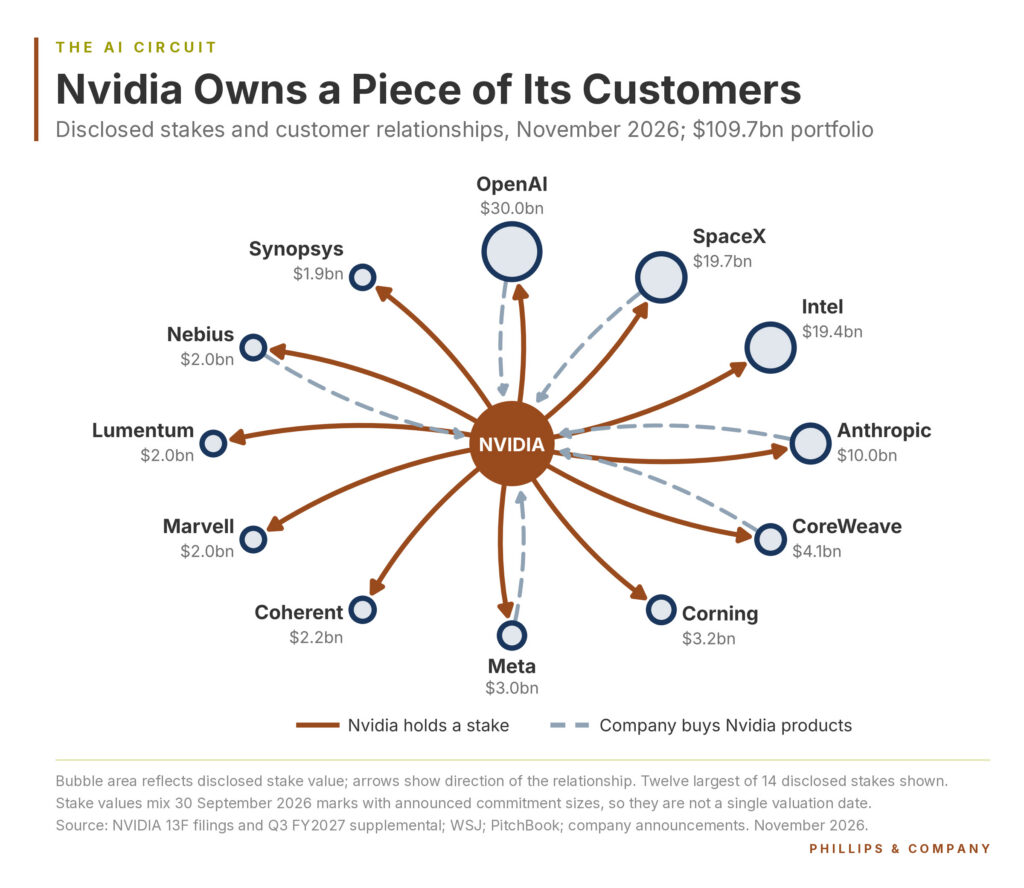
The questions extend beyond Nvidia. Investors are concerned about the returns on hundreds of billions of dollars of data center construction, the availability and cost of electricity, the sustainability of capital spending and how quickly AI will produce measurable economic benefits.
These are legitimate issues. The amount of capital being committed is enormous, and some investments will undoubtedly disappoint. We have seen enough technological revolutions to know that identifying a transformational technology is considerably easier than determining who ultimately makes money from it.
Huang’s return may provide some reassurance to investors, but the financial questions surrounding AI will be answered by earnings, cash flows and investment returns.
Meanwhile, the underlying financial performance of American businesses remains remarkably strong.
Earnings Are Doing Their Part
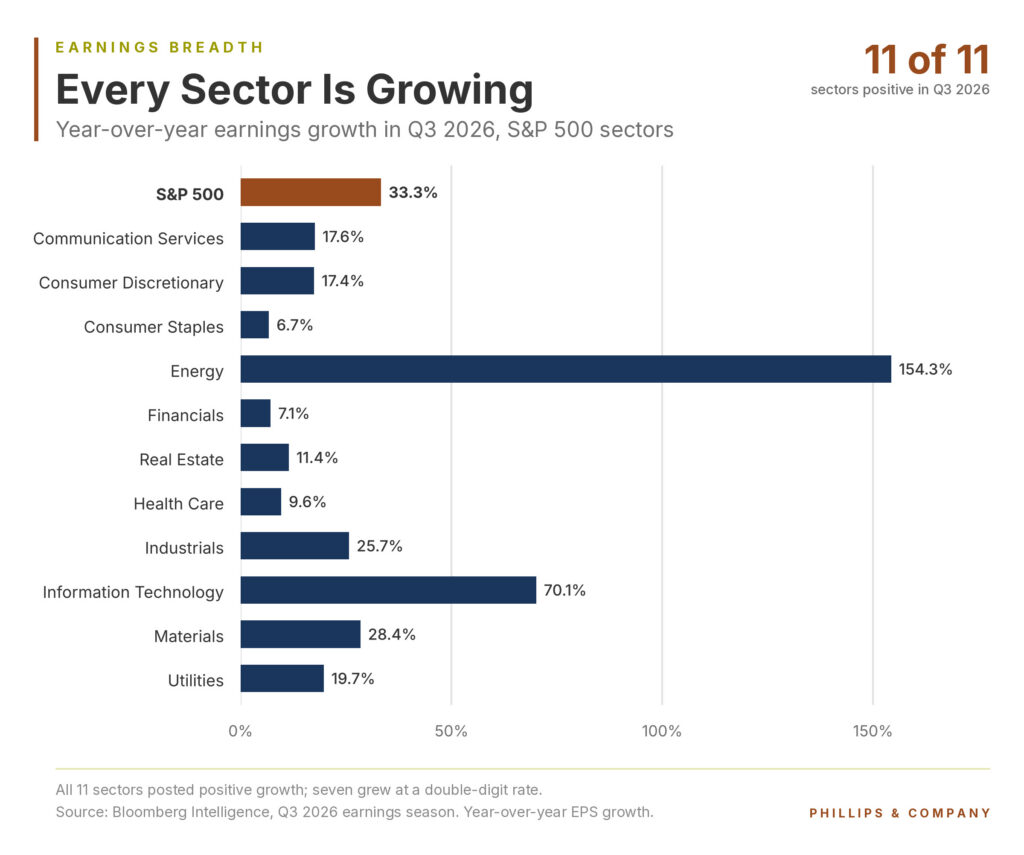
Corporate America continues to report excellent results. Third-quarter S&P 500 earnings grew approximately 33% from a year earlier, with all eleven sectors reporting positive growth. Seven of those sectors produced double-digit increases.
Technology remains an important contributor, but earnings growth is extending well beyond the companies building artificial intelligence infrastructure. Industrials, materials, communication services and consumer discretionary businesses are all participating.
This breadth matters. A market supported by earnings growth across the economy has a more durable foundation than one relying exclusively on a handful of technology companies.
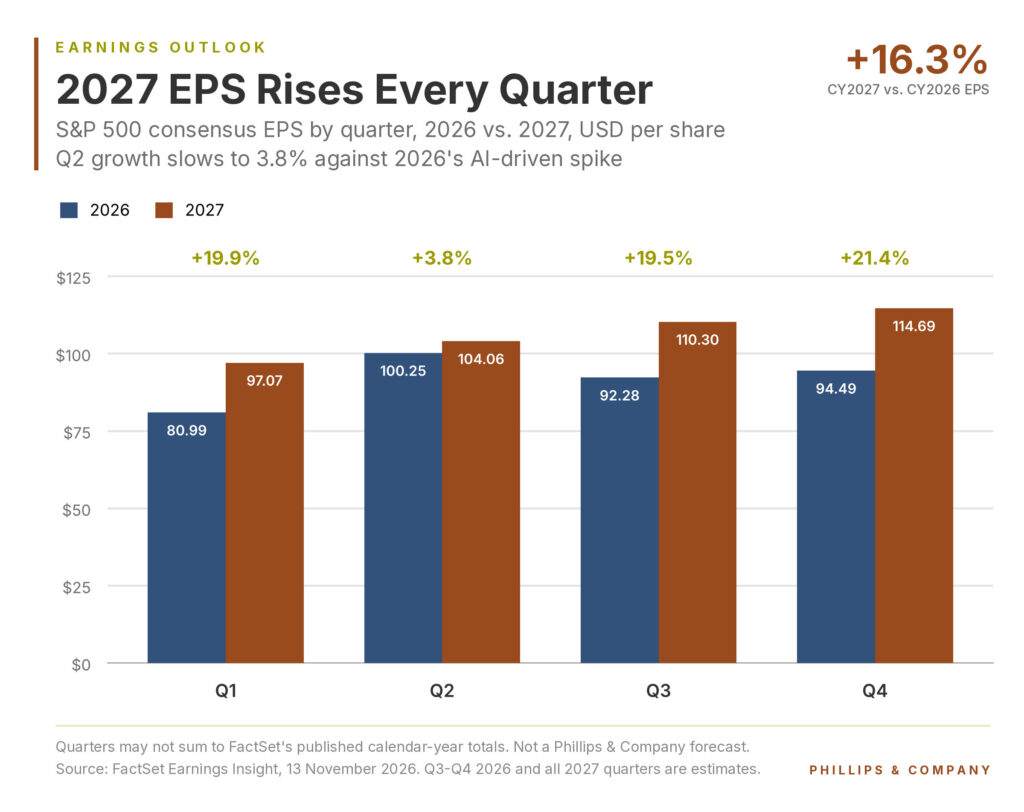
The outlook for next year is encouraging as well. Current consensus estimates anticipate approximately 16% earnings growth for the S&P 500 in 2027. Earnings are expected to increase in every quarter, although the rate of growth will fluctuate as companies compare results against an unusually strong 2026.
These estimates will change, of course. They always do. But the starting point is favorable, especially considering the anxiety now surrounding equity markets.
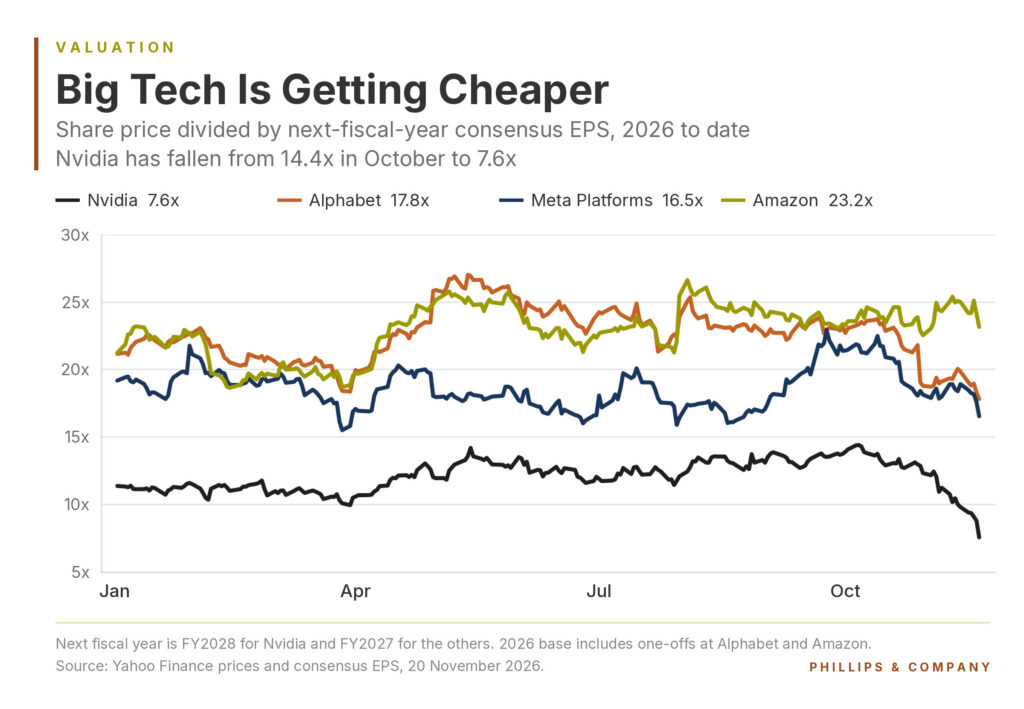
The recent pullback also means investors are paying less for those future earnings than they were just a few weeks ago. If corporate profits continue growing while share prices decline, valuations become more attractive. That process can be uncomfortable, but it is part of how markets adjust expectations.
Some of the largest technology companies have experienced meaningful multiple compression this year. Investors who were previously willing to pay extraordinary prices for anticipated growth are now demanding more evidence that those expectations can be achieved.
The Consumer Hasn’t Left the Building
The American consumer continues to provide another important source of economic support.
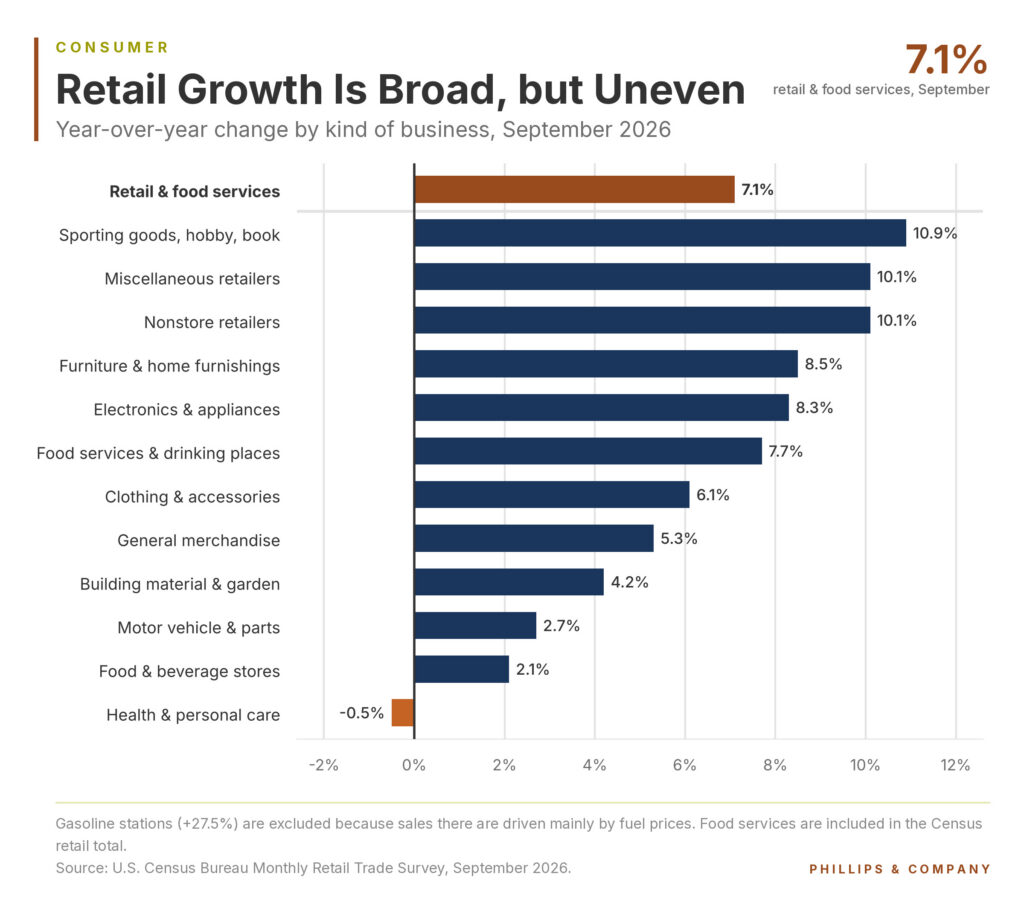
September retail and food services sales increased 7.1% from a year earlier. Growth was widespread, with spending on sporting goods, online retail, furniture, electronics and restaurants all showing healthy increases.
Consumers are certainly feeling the cumulative impact of inflation. Prices remain elevated, borrowing costs are significant and households have become more selective about where they spend their money. But the spending data continue to suggest an economy with considerable resilience.
Household wealth also remains an important part of this story.
Over time, rising home values, retirement accounts and equity portfolios have contributed to consumers’ willingness and ability to spend. Recent gains in financial assets have played an especially meaningful role in supporting consumption, particularly among higher-income households.
There is a vulnerability here. Declining equity prices can reduce that support, and a prolonged market correction could eventually affect consumer behavior. The wealth effect works in both directions.
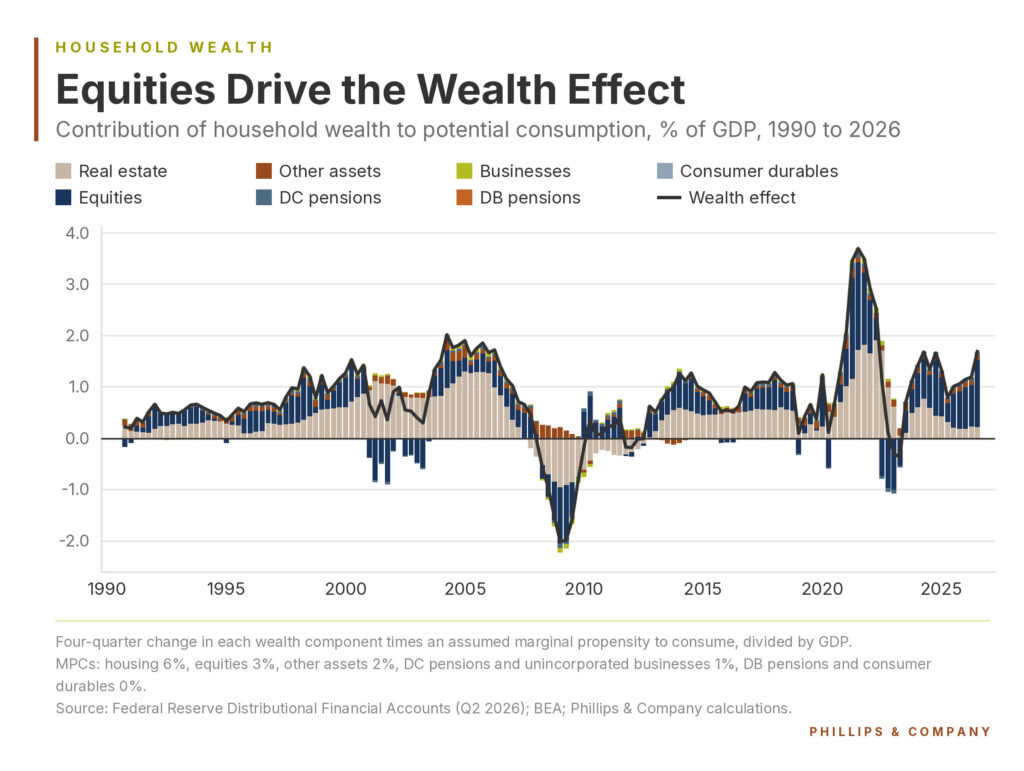
For now, however, the combination of consumer spending and corporate profitability provides a reasonable foundation for continued economic growth.
Markets Have Their Own Expectations
Despite these favorable fundamentals, the stock market has experienced a sharp reversal.
The S&P 500 has retreated meaningfully from its recent high, while the technology-heavy Nasdaq has experienced an even more pronounced decline. The damage beneath the surface has been more significant than either major index suggests.
According to the accompanying November 20 analysis, 65% of Nasdaq-100 securities were trading at least 20% below their 52-week highs. The estimated loss in market value across the group totaled $16.2 trillion from those individual highs.
Many companies associated with AI infrastructure, semiconductors and cloud computing have experienced particularly substantial declines.
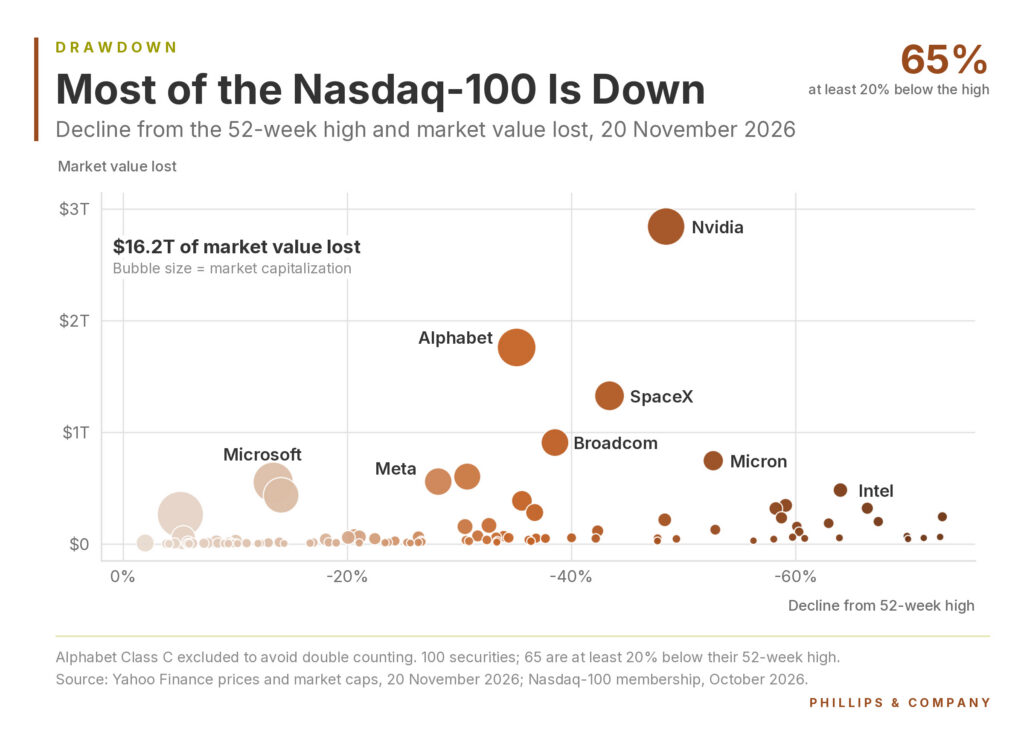
Much of this selling reflects concerns about how much growth investors had already incorporated into share prices. Strong earnings alone cannot prevent a stock from declining when expectations were even stronger.
The semiconductor industry provides a particularly good example. Nvidia continues to report extraordinary financial results, yet investors have become increasingly focused on the sustainability and financing of future demand.
Eventually, companies will need to demonstrate that the enormous infrastructure investments being made today generate attractive economic returns.
I suspect many will. Others will find that building something valuable does not necessarily mean they have built something profitable.
The Price of Admission
Market corrections are unsettling, particularly when they occur quickly and appear inconsistent with the economic data.
But history offers some useful perspective.
Over the past six decades, the S&P 500 has experienced repeated declines of 10%, 20% and occasionally much more. The bear market of 1973–74 approached 50%. The financial crisis produced a decline of approximately 57%. Even the relatively brief pandemic decline exceeded 30%.
Each of those periods felt different while investors were living through it. Each came with its own convincing argument for why the market might never fully recover.
Yet the market ultimately recovered and established new highs, supported by economic growth, innovation and the ability of American businesses to generate ever-greater profits.
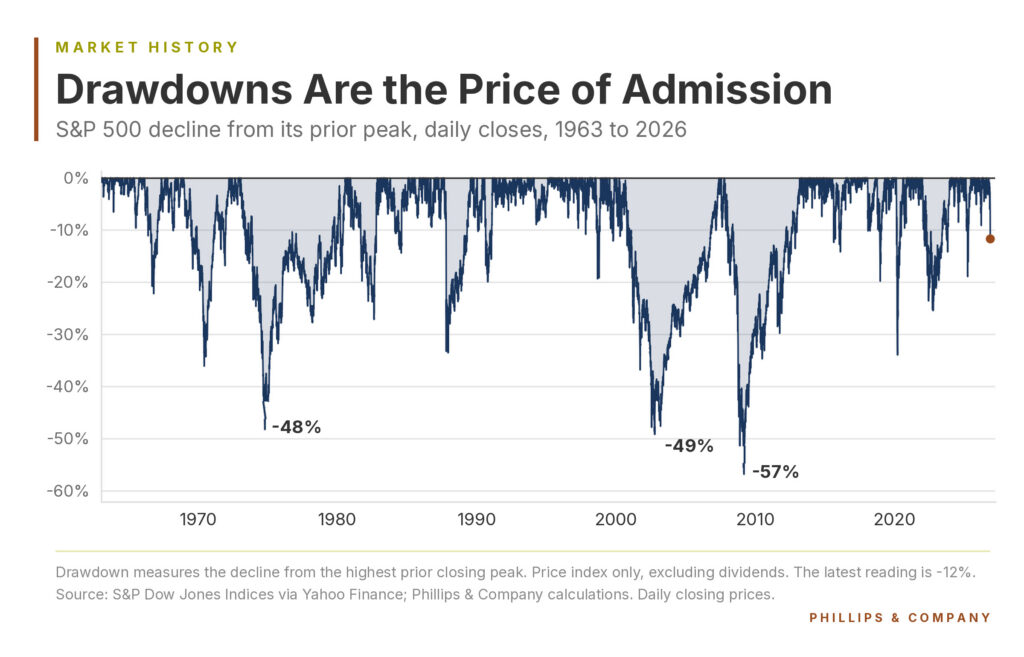
That historical outcome does not tell us when the current correction will end. Nor does it eliminate the possibility of further declines. Markets have a remarkable ability to remain uncomfortable longer than investors would prefer.
It does remind us that volatility has always been part of long-term equity ownership.
There is no admission ticket that allows investors to participate in decades of economic growth while avoiding the occasional substantial decline in their portfolios.
Looking Ahead
I remain encouraged by what we are seeing in corporate earnings and consumer activity.
AI is likely to remain an important source of investment, innovation and productivity growth, although the benefits will not be distributed evenly among the companies participating in its development. We should expect greater scrutiny of capital spending, financing arrangements and the returns those investments ultimately produce.
That scrutiny is healthy. Capital markets work best when investors demand evidence that their money is being put to productive use.
The economy will continue to face challenges. Inflation, interest rates, political uncertainty and the possibility of weaker consumer confidence all deserve attention. And after a decline of this magnitude, we should be prepared for continued volatility.
But the financial condition of American businesses, the breadth of earnings growth and the resilience of consumer spending offer reasons for optimism.
I don’t know where the market will trade next week or next month. I am considerably more confident in the capacity of American businesses to innovate, adapt and grow over the coming years.
Successful investing has always required patience through periods when that confidence is tested.
The price of admission can be high. History suggests that, for investors willing and able to stay invested through the difficult periods, the long-term opportunity has been worth paying for.
If you have questions or comments, please let us know. You can contact us via X and Facebook, LinkedIn, or you can e-mail Tim directly. For additional information, please visit our website.
Tim Phillips, CEO, Phillips & Company
Sources & Data References:
FactSet Earnings Insight (November 13, 2026); Bloomberg Intelligence Q3 2026 earnings analysis; U.S. Census Bureau Monthly Retail Trade Survey (September 2026); Federal Reserve Distributional Financial Accounts (Q2 2026); Bureau of Economic Analysis; Nvidia SEC filings, earnings releases and company announcements; S&P Dow Jones Indices; Yahoo Finance historical market data and consensus earnings estimates (November 20, 2026); and Phillips & Company calculations. Market data reflect information available through November 20, 2026. Forward earnings estimates are based on analyst consensus and are subject to revision. Historical market performance does not guarantee future results.
The charts and data presented are sourced from a combination of public domain materials and licensed data providers. Their use is intended solely for educational and analytical commentary and falls within the scope of fair use. For a representative list of sources, please click here.
The material contained within (including any attachments or links) is for educational purposes only and is not intended to be relied upon as a forecast, research, or investment advice, nor should it be considered as a recommendation, offer, or solicitation for the purchase or sale of any security, or to adopt a specific investment strategy. The information contained herein is obtained from sources believed to be reliable, but its accuracy or completeness is not guaranteed. All opinions expressed are subject to change without notice. Investment decisions should be made based on an investor’s objective.