
In the early 1870s, America was laying railroad track at a remarkable pace. The railroads were transforming the country, but somebody had to pay for all that steel, land, and labor. Much of the money came from bonds sold to private investors.
Those railroad bonds competed with government debt for the same pool of capital. They paid more because they carried more risk, but the income was attractive and the story was compelling. Investors could finance the infrastructure of the future and earn a better return while doing it.
That worked until the volume of bonds became more than the market could comfortably absorb. Financing costs rose, weaker projects struggled, and the failure of Jay Cooke & Company in 1873 helped set off a long economic contraction.
I am not suggesting that data centers are the railroads of 1873 or that another financial panic is around the corner. History rarely repeats that neatly. But the basic mechanics have not changed. When private borrowers offer investors an attractive alternative, the government must compete for their money. That competition is beginning to show up in long-term interest rates.
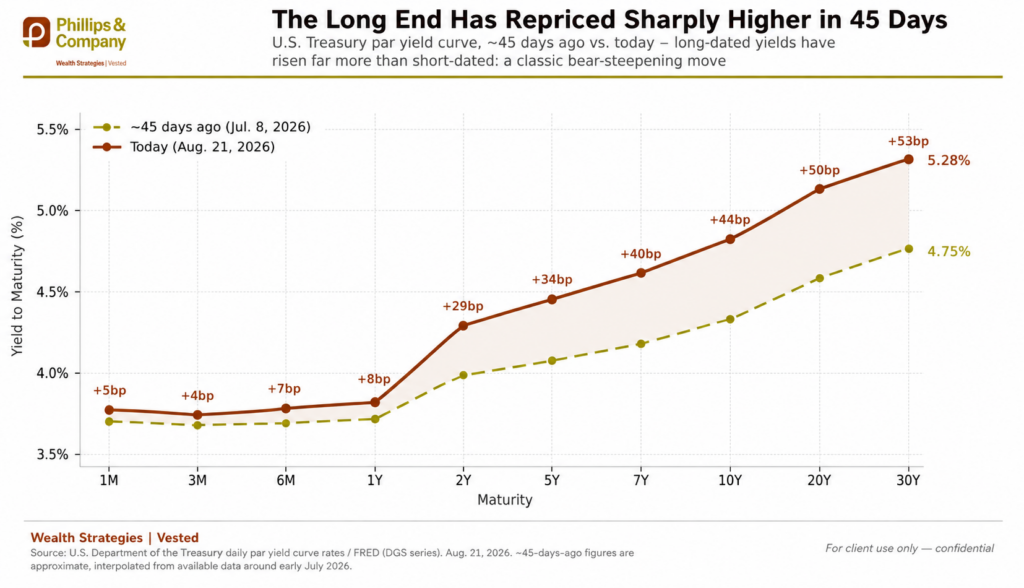
The Treasury curve has moved sharply higher over the last 45 days, with most of the damage concentrated at the long end. The 30-year Treasury yield has risen from approximately 4.75% to 5.28%, while the shortest maturities have barely moved.
That is a classic bear steepening of the yield curve. The market is demanding more compensation to lend money for 10, 20, or 30 years. Inflation and the federal deficit are certainly part of that calculation, but I think two changes in demand deserve more attention.
Japan Needs Its Money Back
Japan remains the largest foreign holder of U.S. Treasury securities. For decades, Japan’s trade surplus, high domestic savings, and very low interest rates made Treasuries a natural home for its capital.
A weak yen changes that equation.
When the yen falls too far, Japan can defend its currency by selling dollar assets and using the proceeds to buy yen. Treasuries are among the most liquid dollar assets available. Japan reduced its Treasury holdings from roughly $1.239 trillion in February to $1.117 trillion in June, a decline of about $123 billion.
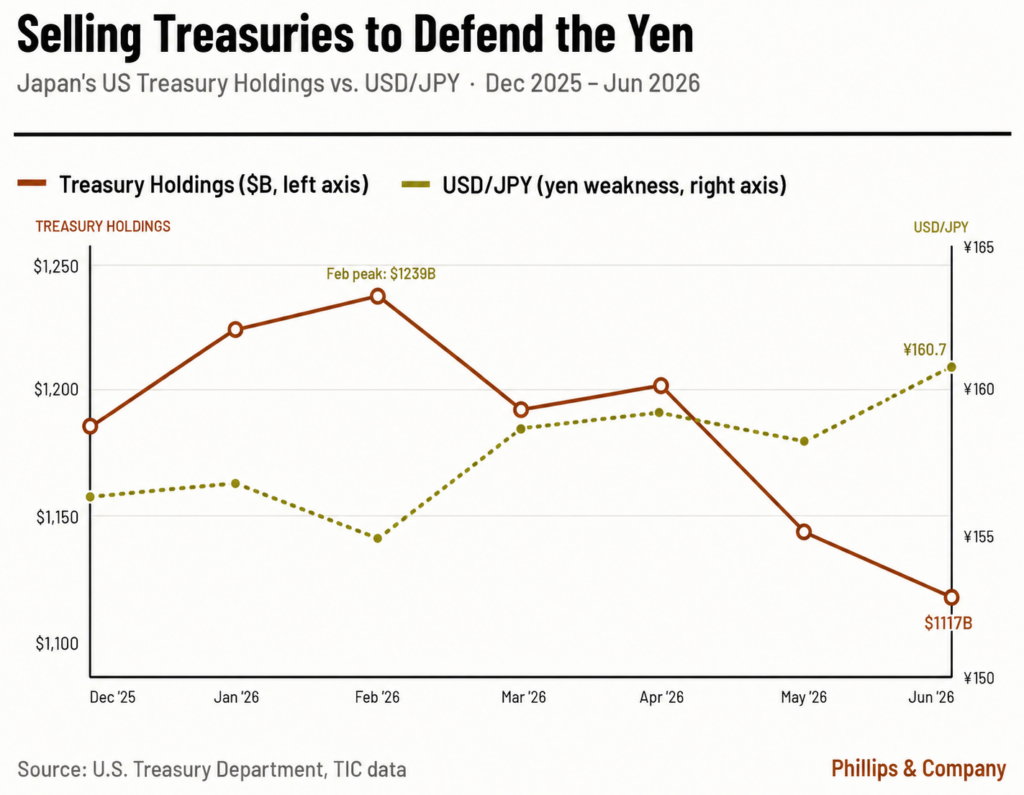
The relationship shown in the chart is hard to ignore. As the yen weakened toward 161 per dollar, Japan’s Treasury holdings declined. Treasury custody data cannot tell us that every dollar sold was used for currency intervention. Japan’s banks, pensions, and private investors also adjust their holdings for their own reasons. Still, the sales occurred while Japan was under considerable pressure to support its currency, and the United States reportedly joined Japan in buying yen at the end of July.
This is defensive behavior. Japan is not necessarily making a broad judgment about the creditworthiness of the United States. It needs the dollars tied up in Treasuries to address a domestic currency problem.
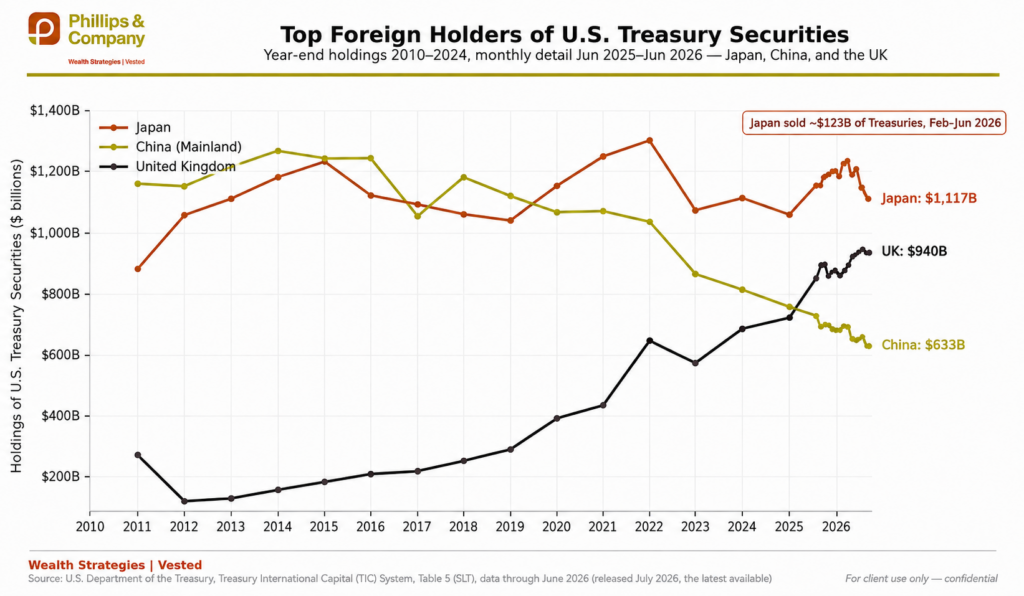
The reason matters less to the bond market than the transaction itself. One of the Treasury’s largest traditional customers has recently become a seller.
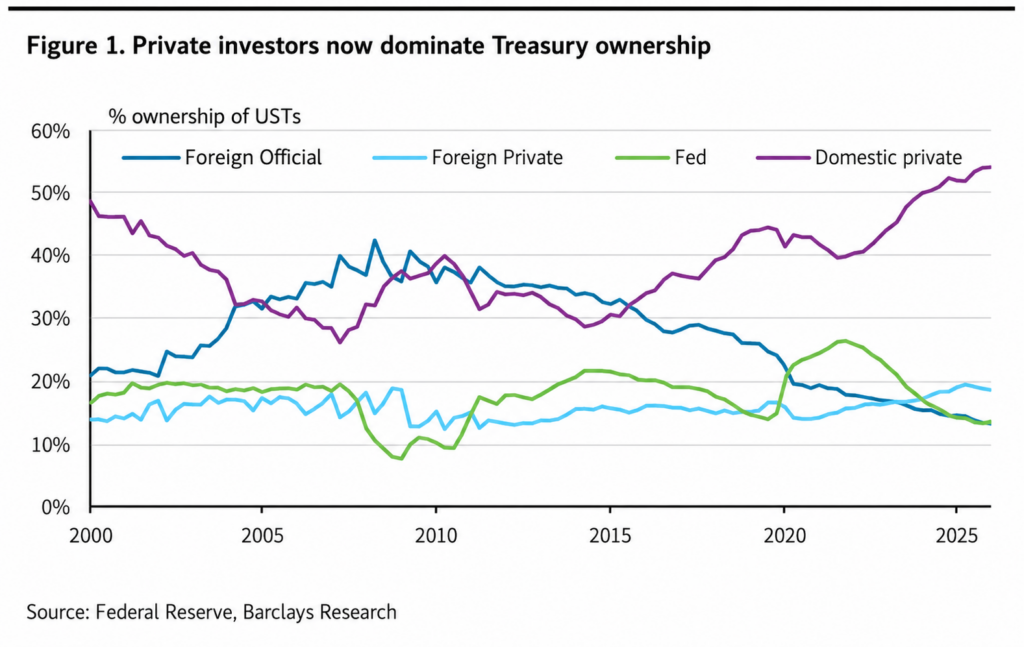
China has been reducing its Treasury exposure for years. Japan’s more recent selling leaves private investors carrying a greater share of the market. Domestic private ownership of Treasuries has climbed above 50%, compared with less than 30% roughly a decade ago.
That shift makes the Treasury market more price-sensitive.
Foreign central banks often held Treasuries for reserve management, exchange-rate policy, and trade-related reasons. Private investors have different mandates. They compare yield, credit quality, liquidity, and expected return. They are under no obligation to finance Washington if another bond offers them a better deal.
The Data Center Is Competing with the Treasury Department
The second demand issue comes from the enormous amount of capital being raised to build AI infrastructure.
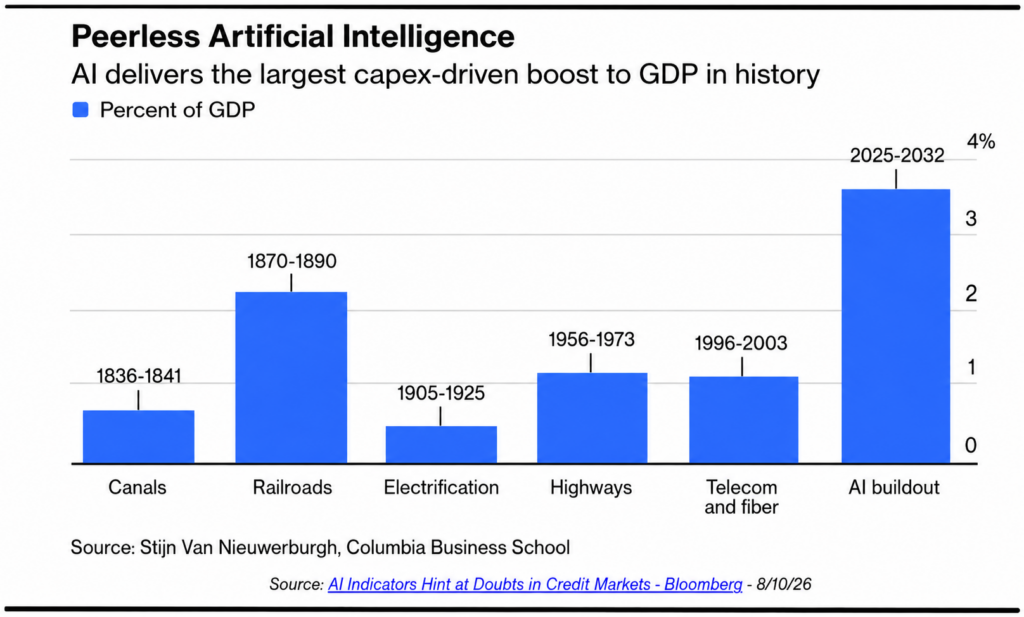
Data centers require land, chips, power generation, transmission capacity, cooling systems, and long-term energy contracts. The scale is large enough to affect the broader fixed-income market. Goldman Sachs estimates that hyperscalers could issue roughly $250 billion in debt in 2026, before including project financing and other debt raised around the data-center ecosystem.
This creates a new supply of long-duration bonds at precisely the time when the Treasury is asking investors to absorb its own heavy issuance.
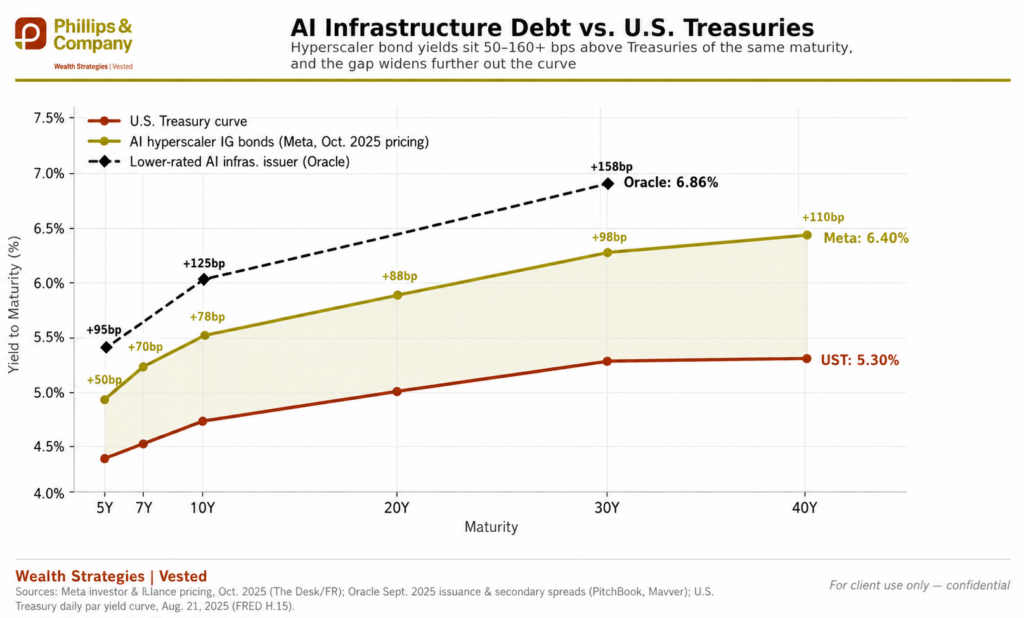
The comparison illustrates the choice. A long-term Treasury yields around 5.3%. Comparable Meta infrastructure debt can offer approximately 6.4%, while lower-rated AI infrastructure debt can approach 6.9%.
Those spreads are not free money. Corporate and project debt carries credit, execution, and liquidity risk that Treasuries do not. But for pensions, insurance companies, private-credit funds, and wealthy individual investors, an additional 100 to 160 basis points can be compelling.
The Dallas Fed has described three ways this financing can affect rates: direct issuance of long-duration debt, interest-rate hedging connected to the projects, and displacement as investors choose AI-related credit instead of Treasuries. All three put upward pressure on the amount of yield required to clear the long end of the government bond market.
Private investors now have a lot of merchandise to choose from, and Washington no longer has the store to itself.
Why the Fed and Treasury Are Buying
There is an important distinction between what the Federal Reserve is doing and what the Treasury is doing.
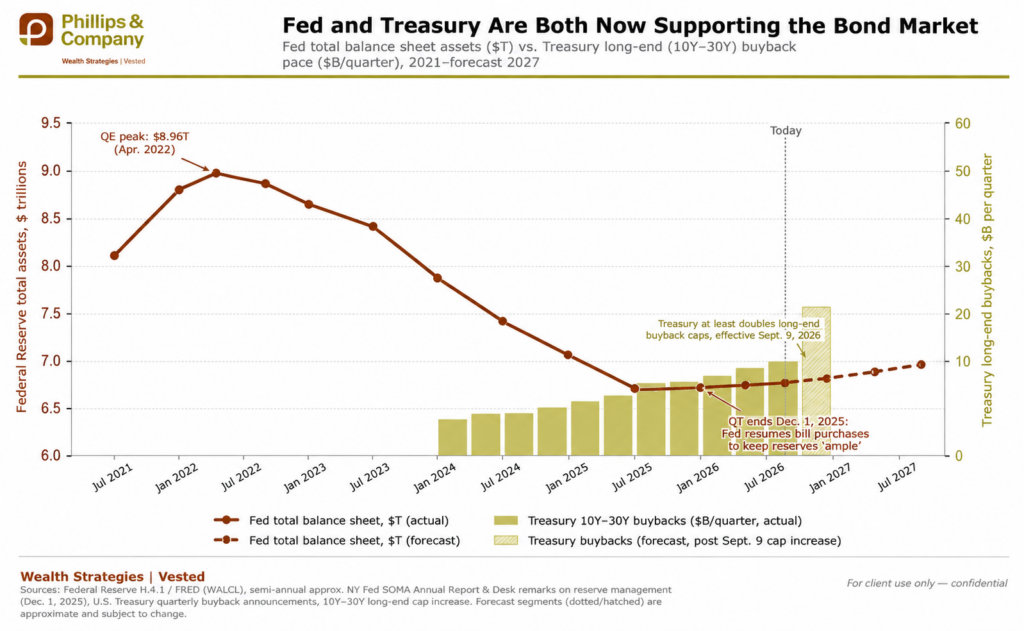
The Fed ended quantitative tightening in December 2025 and resumed purchases of shorter-term Treasury securities to maintain an ample level of bank reserves. These are reserve-management purchases. The Fed says their purpose is to keep the federal funds market functioning properly, rather than to stimulate the economy through another round of quantitative easing.
The Treasury’s buybacks are different. The Treasury is repurchasing older, less-liquid securities while continuing to issue new debt. Beginning September 9, it will at least double the maximum size of certain long-end liquidity-support buybacks from $2 billion to $4 billion per operation.
Two Buyers, Two Different Jobs
The Federal Reserve: Buys mostly shorter-term Treasuries to maintain adequate reserves in the banking system and keep short-term interest rates under control.
The Treasury Department: Buys older Treasury securities to improve trading liquidity and manage cash. Its buybacks do not eliminate the government’s financing need because the Treasury is still issuing debt elsewhere.
Neither program is officially designed to cap long-term yields. Together, however, they provide support at a time when traditional buyers are becoming less dependable and private investors have more attractive alternatives.
Calling the Fed and Treasury buyers of last resort may go a little too far in a technical sense. They are not guaranteeing a price or promising to absorb every unwanted bond. But their growing presence tells us something. The market needs help absorbing and recycling the supply already outstanding.
The Cost Arrives with a Lag
A 5.3% 30-year Treasury yield does not stay confined to the Treasury market. It becomes the reference point for mortgages, corporate borrowing, municipal debt, commercial real estate financing, and the discount rates investors use to value businesses.
Higher long-term rates work slowly. A homeowner does not refinance every month. Companies do not replace all their debt at once. Construction projects can continue for a while on financing arranged last year. Eventually, however, debt matures, loans reset, and projects that looked attractive at 4.5% no longer work at 6% or 7%.
That is why the recent move matters. If long rates remain near these levels, they will begin to crimp housing, construction, business investment, and consumer demand over the coming months. The economy can tolerate higher rates for a while, particularly with AI investment providing support. It becomes harder as more borrowers are forced to refinance into them.
The Fed controls the overnight rate more directly than it controls the 30-year yield. The Treasury controls the maturity and timing of government issuance but cannot dictate the price investors will accept. Each institution is acting within its own mandate, and the Fed’s independence should remain intact.
Still, the policy mix matters. The Treasury can reduce unnecessary pressure on the long end through careful issuance and liquidity management. The Fed can respond if restrictive long-term financial conditions begin doing more economic work than policymakers intended. That does not require the Treasury secretary and the Fed chair to set rates together. It requires both institutions to understand that their separate decisions are landing in the same bond market.
For now, that market is sending a fairly direct message. Japan needs some of its money back. AI companies need an enormous amount of new money. Private investors have better-paying alternatives, and the United States is having to compete harder for their capital.
The price of that competition is a higher long-term interest rate. If it lasts, the economic bill will begin arriving later this year.
Perhaps it’s time to recalibrate risk or at least understand what is possible.
If you have questions or comments, please let us know. You can contact us via X and Facebook, or you can e-mail Tim directly. For additional information, please visit our website.
Tim Phillips, CEO, Phillips & Company
Sources & Data References:
Treasury holdings and foreign capital-flow data are from the U.S. Treasury Department’s June 2026 Treasury International Capital release. Federal Reserve balance-sheet policy is based on the Federal Reserve’s December 2025 reserve-management announcement and March 2026 meeting materials. Treasury buyback figures are from the Treasury Department’s August 19, 2026 announcement. AI financing estimates and market effects are drawn from research published by Goldman Sachs and the Federal Reserve Bank of Dallas.
The charts and data presented are sourced from a combination of public domain materials and licensed data providers. Their use is intended solely for educational and analytical commentary and falls within the scope of fair use. For a representative list of sources, please click here.
The material contained within (including any attachments or links) is for educational purposes only and is not intended to be relied upon as a forecast, research, or investment advice, nor should it be considered as a recommendation, offer, or solicitation for the purchase or sale of any security, or to adopt a specific investment strategy. The information contained herein is obtained from sources believed to be reliable, but its accuracy or completeness is not guaranteed. All opinions expressed are subject to change without notice. Investment decisions should be made based on an investor’s objective.